
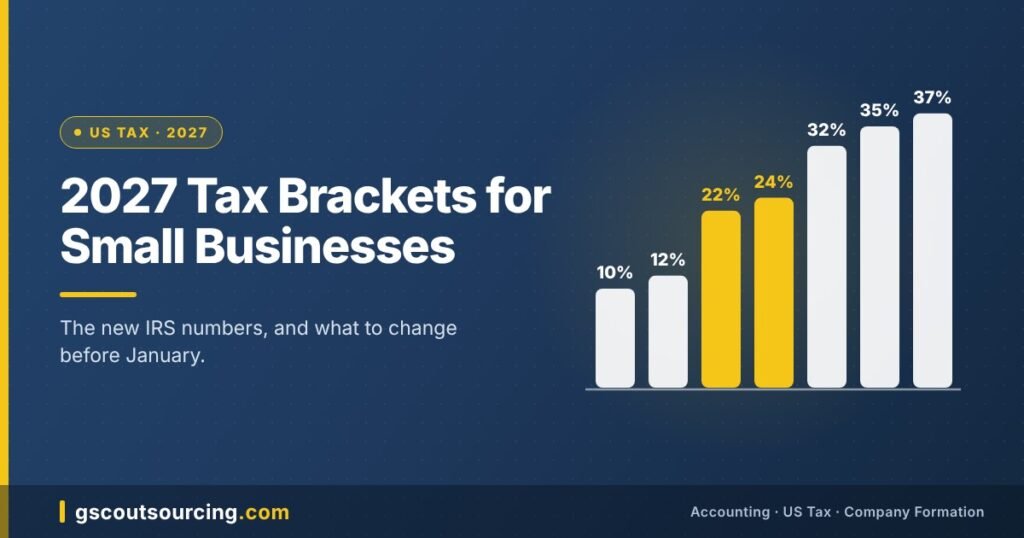
The IRS published the 2027 tax brackets on November 5, 2026, in Revenue Procedure 2026-35. It adjusted almost 70 tax provisions for inflation. If you own a small business, these numbers shape your 2027 estimated payments, owner pay and equipment plans.
Short answer: the 2027 tax brackets keep the same seven rates (10% to 37%) but move every income threshold up for inflation. They apply to tax year 2027, so you will use them on returns filed in 2028, and on estimated payments starting in April 2027.
This guide gives you the full bracket table, the other 2027 limits a business owner should know, and a short plan to act on before the year starts.
| Quick answers What are the 2027 tax brackets? Seven rates from 10% to 37%. The top rate starts above $661,375 for single filers and $793,650 for joint filers. When do they apply? To income earned in 2027, reported on returns filed in 2028. Do they affect my LLC or S corp? Yes. Pass-through profit is taxed on your personal return at these rates. Do they affect a C corporation? No. A C corporation pays a flat 21% federal rate, which is not indexed. What else changed? Section 179 rises to $2,640,000, QBI thresholds rise, and the 1099 threshold becomes $2,100. |
What are the 2027 tax brackets?
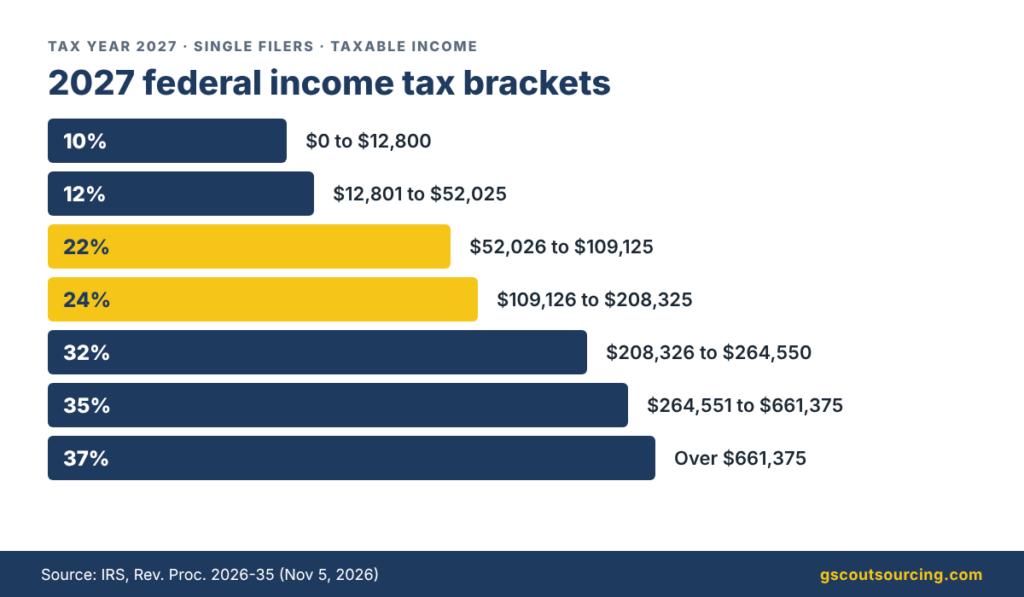
Tax brackets are the income ranges that the IRS taxes at each federal income tax rate. For 2027, the rates stay at 10%, 12%, 22%, 24%, 32%, 35% and 37%, and each range is wider because of inflation.
Each rate applies only to the income inside its range. Your first dollars are taxed at 10%, the next slice at 12%, and so on. Here are the 2027 thresholds from the IRS, based on taxable income.
| Rate | Single | Married filing jointly | Head of household |
| 10% | $0 to $12,800 | $0 to $25,600 | $0 to $18,250 |
| 12% | Over $12,800 | Over $25,600 | Over $18,250 |
| 22% | Over $52,025 | Over $104,050 | Over $69,650 |
| 24% | Over $109,125 | Over $218,250 | Over $109,100 |
| 32% | Over $208,325 | Over $416,650 | Over $208,300 |
| 35% | Over $264,550 | Over $529,100 | Over $264,550 |
| 37% | Over $661,375 | Over $793,650 | Over $661,350 |
The standard deduction also rises in 2027. It will be $16,600 for single filers (up $500), $33,200 for married couples filing jointly (up $1,000) and $24,925 for heads of household. Personal exemptions stay at zero.
When do the 2027 tax brackets take effect?
The 2027 brackets apply to income you earn from January 1 to December 31, 2027. You report that income on the return you file in 2028.
This trips people up every year. The return you file in early 2027 covers 2026, so it uses the 2026 numbers. The 2027 figures matter sooner than the 2028 filing season, though. Your first 2027 estimated tax payment is generally due in mid-April 2027, and payroll withholding for owner salaries will follow the new tables from January.
These changes come on top of the 2025 tax law, the One Big Beautiful Bill Act, which the IRS now calls the Working Families Tax Cuts. That law made the 20% qualified business income (QBI) deduction permanent and restored 100% bonus depreciation for property acquired after January 19, 2025.
Do the 2027 brackets apply to my LLC, S corp or C corp?
The 2027 tax brackets apply to you personally, so they cover profit from a sole proprietorship, a single-member LLC, a partnership or an S corporation. They do not apply to a C corporation, which pays a flat 21% federal rate.
• Sole proprietor or single-member LLC: your business profit lands on Schedule C of your personal return and is taxed at your bracket.
• Partnership or multi-member LLC: each owner pays tax on their share of profit at their own bracket.
• S corporation: your salary and your share of profit both flow to your personal return. The brackets affect both.
• C corporation: the company pays 21% on its profit. You only meet the brackets on salary and on dividends (dividends have their own rates).
If you are not sure which basis your books use, our cash vs. accrual guide explains how timing affects the profit you report each year.
Which other 2027 limits matter to a small business?
Beyond the brackets, the most useful 2027 numbers for owners are the Section 179 limit, the QBI deduction thresholds, the new 1099 threshold and the excess business loss limit.
| Item | 2027 figure | Why it matters |
| Section 179 expensing limit | $2,640,000; reduced once purchases pass $4,230,000 | Lets you deduct qualifying equipment in the year you place it in service. |
| Section 179 limit for SUVs | $33,100 | Caps the up-front deduction on heavy SUVs. |
| QBI deduction threshold | $208,300 (most filers); $416,600 (joint) | Below this, the 20% QBI deduction is simplest to claim. |
| QBI phase-in range ends | $283,300 (most filers); $566,600 (joint) | Above the threshold, wage and service-business limits phase in. |
| QBI minimum deduction | $415, if you have at least $1,030 of QBI from active businesses | A new floor for small active businesses. |
| 1099 reporting threshold | $2,100 for payments made in 2027 | Up from $2,000 in 2026 and $600 before that. |
| Excess business loss limit | $264,000 (single); $528,000 (joint) | Caps how much business loss can offset other income. |
| Information return penalty | $360 per late return (returns due in 2028) | Applies to late or missing 1099s. |
| Health FSA and commuter benefits | $3,500 FSA; $350 per month transit or parking | Sets 2027 limits for employee benefit plans. |
The QBI thresholds are worth a careful look. If your 2027 taxable income will land near $208,300 (or $416,600 for joint filers), the timing of income and deductions can change how much of the 20% deduction you keep.
How should I plan for 2027 now?
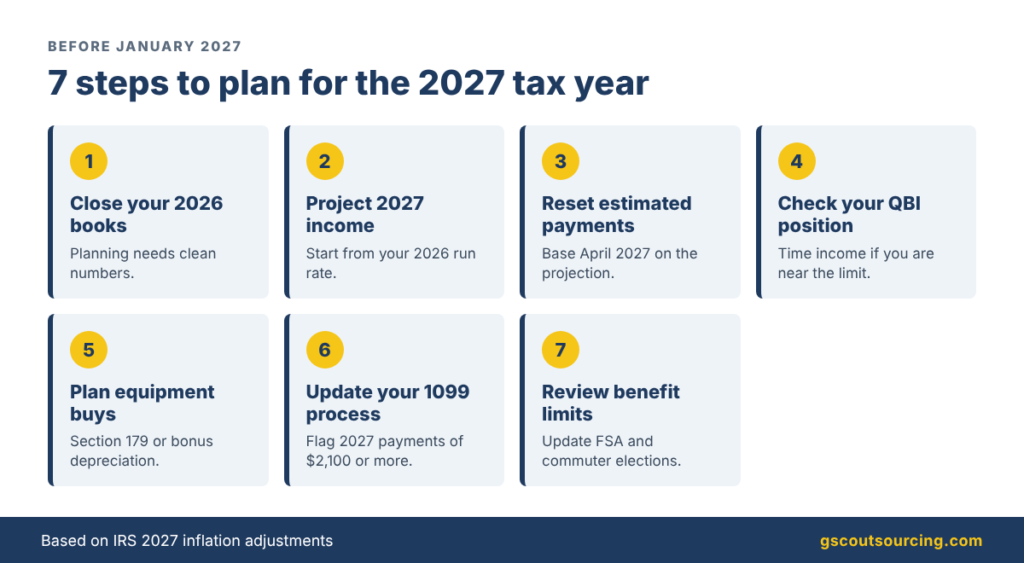
Use November and December 2026 to set up 2027: update estimates, pick the right owner pay, time big purchases and fix your 1099 process.
- Close your 2026 books on time. Planning only works with clean numbers. If month-end close keeps slipping, outsourced bookkeeping and month-end close can fix that before year-end.
- Project 2027 taxable income. Use your 2026 run rate and any known changes, such as a new hire, a new contract or a price increase.
- Reset estimated payments. Base your April 2027 payment on the projection, not on last year by habit.
- Check your QBI position. If you will be near the threshold, talk to your preparer about timing income and retirement contributions.
- Plan equipment purchases. Decide whether Section 179 or bonus depreciation fits, and when to place assets in service.
- Update your 1099 process. Collect W-9 forms now and set your vendor report to flag 2027 payments of $2,100 or more.
- Review benefit limits. Update FSA and commuter benefit elections for the new caps.
| Need a 2027 cash and tax forecast? Our CFO and financial planning support builds budgets and cash-flow forecasts, so tax payments never surprise you. See CFO and FP&A support |
What is the difference between my marginal and effective rate?
Your marginal rate is the rate on your last dollar of income. Your effective rate is your total tax divided by your taxable income, and it is always lower.
Take a single owner with $100,000 of taxable income in 2027:
• The first $12,800 is taxed at 10%: $1,280.
• The next $39,225 (up to $52,025) is taxed at 12%: $4,707.
• The last $47,975 is taxed at 22%: $10,554.50.
Total federal income tax is $16,541.50. The marginal rate is 22%, but the effective rate is about 16.5%. That gap matters when you decide whether one more deduction is worth chasing. A $10,000 deduction for this owner saves $2,200, not $1,650.
This example leaves out self-employment tax, state tax and credits. Your preparer should run your real numbers. If you hand that work to an outside firm, here is how to outsource tax preparation well.
Frequently asked questions
What are the 2027 federal tax brackets?
The 2027 brackets keep seven rates: 10%, 12%, 22%, 24%, 32%, 35% and 37%. For single filers, the 37% rate starts above $661,375. For married couples filing jointly, it starts above $793,650. The IRS published the figures in Revenue Procedure 2026-35 on November 5, 2026.
When do the 2027 tax brackets take effect?
They apply to income earned from January 1 to December 31, 2027. You report that income on the return you file in 2028. Returns filed in early 2027 cover 2026, so they use the 2026 figures. Your 2027 estimated payments and payroll withholding should follow the new numbers.
What is the standard deduction for 2027?
For tax year 2027, the standard deduction is $16,600 for single filers and married people filing separately. It is $33,200 for married couples filing jointly and $24,925 for heads of household. Personal exemptions stay at zero. Business owners who itemize should compare both options each year before filing.
Do the 2027 tax brackets apply to an LLC?
Usually, yes. A single-member LLC or multi-member LLC is taxed as a pass-through by default, so its profit flows to the owners' personal returns and is taxed at their brackets. An LLC that elects to be taxed as a C corporation pays the flat 21% corporate rate instead.
What is the Section 179 limit for 2027?
For tax years beginning in 2027, a business can expense up to $2,640,000 of qualifying property under Section 179. The limit starts to shrink, dollar for dollar, once qualifying purchases in the year pass $4,230,000. Heavy SUVs have a separate cap of $33,100.
What is the 1099 threshold for 2027?
For payments made in calendar year 2027, the reporting threshold for Form 1099-NEC and most Form 1099-MISC payments is $2,100. It was $2,000 for 2026 payments and $600 before that. The threshold is now adjusted for inflation each year, so update your vendor reports before January.
| Plan 2027 with a tax team that checks every number The 2027 brackets only help if your books, payroll and estimated payments line up with them. That is the work our US tax team does every year for small business owners. Talk to our US tax team |
Related reading: Cash vs. Accrual Accounting: Which Basis Fits Your Growing Business? · Estimated Tax Payments for 2026: Who Pays and When · What Is Sales Tax Nexus? Economic Nexus Rules for Small Business
