
Amazon.com is the biggest online marketplace many sellers outside the US will ever reach. You don't have to live in the US to sell there, but the registration asks for documents, bank details and tax information that trip up a lot of first-time sellers.
This guide explains how an Amazon seller account for non-residents works, what Amazon asks for, when a US LLC makes sense, and which US tax and sales tax points to sort out before your first order.
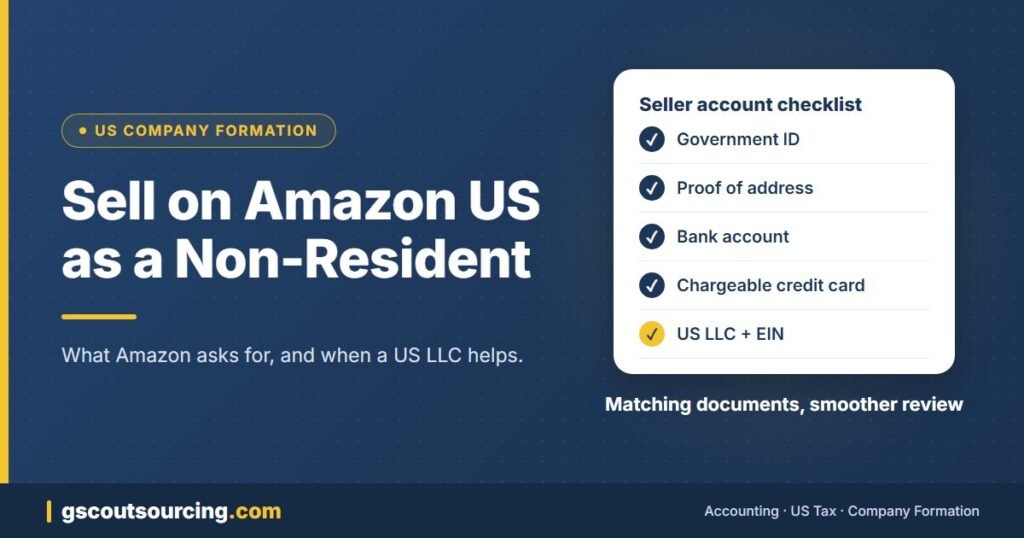
Non-residents can open an Amazon US seller account directly from their home country. Amazon asks for a government ID, proof of address, a bank account, an internationally chargeable credit card, tax information and business details, then verifies your identity by photo or video call. Many sellers form a US LLC first so the business, its EIN and a US bank account all line up, but approval is always Amazon's decision.
Quick answers
- Can a non-resident sell on Amazon US? Yes. Amazon accepts sellers from many countries.
- Do I need a US LLC? Not always, but it helps with US banking, payments and a cleaner tax setup.
- What does it cost? Amazon lists $39.99 a month for Professional, or $0.99 per item sold on Individual, plus selling fees.
- How is identity checked? A photo of you with your ID, or a video call with an Amazon associate.
- Who collects sales tax? Amazon does on orders shipped to states with marketplace facilitator laws.
Can non-residents open an Amazon seller account?
Yes. Amazon lets sellers from outside the US register for Amazon.com, either as an individual or as a business.
The question most founders really face is not "can I?" but "which entity should sell?". You can register with your home-country business, or form a US company and register that. Both are allowed. What matters is that every document you upload matches: the business name, the registration certificate, the bank account holder and the address.
Mismatches are a common reason verification stalls. If the business on the application is a US LLC, the bank account, ID of the person verifying, and tax details should all point back to that LLC and its owner.
What does Amazon ask for when you register?
Amazon's registration guide lists identity, address, bank, card, tax and business details, then an identity check.
| Item | What Amazon asks for | Tip for non-residents |
|---|---|---|
| Identity | Government-issued ID | Use a passport that is valid well beyond the review period |
| Address | Proof of residential address dated within the last 180 days | A recent bank or card statement in the same name as the ID |
| Bank account | An account to receive payouts | A US account in the LLC's name keeps everything consistent |
| Credit card | A card Amazon can charge internationally | Check your card allows international charges |
| Business details | Legal name, registration number, registered address, phone | Copy names exactly as they appear on state documents |
| Tax information | Completed through Amazon's tax interview | Have the EIN ready if you use a US company |
The full list is on Amazon's seller registration guide. Read it the day you apply, because requirements change.
Do you need a US LLC to sell on Amazon as a non-resident?
No, but many non-US sellers form one because it makes US banking, payment providers and bookkeeping simpler.
A US LLC gives the business a US legal identity. With it you can get an EIN from the IRS, apply for a US business bank account, and keep Amazon income separate from your personal finances. Other US platforms, such as Stripe, also expect a US-registered business for a US account.
- Reasons founders form a US LLC: US payouts in dollars, a US bank account, one entity for Amazon and their own store, and a structure US partners recognize.
- Reasons some don't: they already have a home-country company that Amazon accepts, and they want to avoid US annual filings.
A US LLC owned by a non-resident has its own yearly filing duties, so weigh that before you decide. Our step-by-step guide to US company formation for non-residents walks through the full setup.
Selling on Amazon US?
We form your US LLC, get its EIN without an SSN and guide your bank application.
How do you register as an Amazon seller from abroad, step by step?
Decide which business will sell, gather matching documents, register on Seller Central, complete the tax interview and finish identity verification.
- Choose the selling entity. Your home-country company, or a US LLC formed for the purpose.
- Get the EIN if you use a US company. Non-residents can apply without an SSN, as our guide to getting an EIN as a non-resident explains.
- Open the bank account that will receive Amazon payouts, in the same name as the selling business.
- Pick a selling plan. Professional suits most sellers expecting regular volume; Individual suits occasional sales.
- Register and complete the tax interview. It decides which IRS form (W-9 or a W-8 version) you provide. How a foreign-owned LLC answers depends on its tax classification, so confirm it with a tax adviser.
- Verify your identity. Upload your ID and proof of address, then take a photo with your ID or join a video call with an Amazon associate.
No formation service or adviser can guarantee an Amazon account. Amazon reviews each application under its own rules. What you control is clean, consistent documents.
Who handles sales tax on Amazon orders?
For orders shipped to states with marketplace facilitator laws, Amazon calculates, collects and remits the sales tax for you.
Amazon explains this on its Marketplace Tax Collection page. It also notes that some local taxes fall outside those laws. Some states may still expect a seller to register or file even when Amazon collects, especially if you hold inventory there or sell through other channels.
Your own Shopify store or website is different: there, you are responsible for sales tax once you have nexus in a state. Our guide to sales tax nexus explains how states decide that.
What US tax filings does a non-resident Amazon seller have?
It depends on the structure. A single-member US LLC owned by a non-resident files Form 5472 with a pro forma Form 1120 every year, even with no US tax due.
- Form 5472 and pro forma 1120. Required for foreign-owned single-member LLCs. The IRS Form 5472 instructions set a $25,000 penalty for not filing.
- Income tax. Whether you owe US income tax depends on whether the business is engaged in a US trade or business. Inventory in US warehouses and US staff can change the answer.
- State filings. Each state has its own annual report or tax for LLCs.
- Home-country tax. Your home country may tax the same income. Check with a local adviser.
Our guide to Form 5472 for foreign-owned LLCs covers that filing in detail.
Not sure which US filings your Amazon business will owe? Book a free 30-minute call and we'll map them out with you.
Frequently asked questions
Straight answers to what non-US sellers ask about Amazon US.
Can I sell on Amazon US without living in the US?
Yes. Amazon accepts sellers from many countries. You register online, upload your ID and documents, and complete identity verification by photo or video call. Keep every document in the same name to avoid delays.
Do I need an SSN or ITIN to sell on Amazon?
Not if you register a business with an EIN. A US LLC can get an EIN without the owner having an SSN or ITIN. Your personal tax situation may still require an ITIN later.
Which Amazon selling plan should I choose?
Amazon lists the Professional plan at $39.99 a month plus selling fees, and the Individual plan at $0.99 per item sold plus selling fees. Sellers who expect more than a handful of sales a month usually choose Professional.
Can my US LLC use a non-US bank account for Amazon payouts?
Check Amazon's current payout options for your country before you register. Whatever you choose, keeping the bank account in the same name as the selling business avoids verification problems. Many US LLC owners use a US business account, and approval for that account is the bank's decision.
How much does it cost to set up a US LLC for Amazon?
State filing fees differ and are set by each state, and some states also charge an annual tax or report fee. Add the cost of a registered agent and the yearly federal filings to get the real total, not just the formation fee.
The bottom line
Non-residents can sell on Amazon US. The smoothest applications use one business throughout, with matching documents, bank account and tax details. A US LLC often makes that easier, but it brings yearly US filings. Plan both before you register, and check your home-country rules with a local adviser.
Set up your US company the right way
Talk to a GSC Outsourcing partner about the right entity and state for your Amazon business. We'll explain the setup and the yearly filings before you spend anything.
Related reading: How to Open a US Bank Account for Your LLC as a Non-Resident (2026 Guide) · Do I Need an LLC to Sell Online? A Guide for Non-US Sellers
