
Every CPA firm owner knows the feeling in late November. Engagement letters are going out, last year's extensions are barely done, and the team is the same size it was in April.
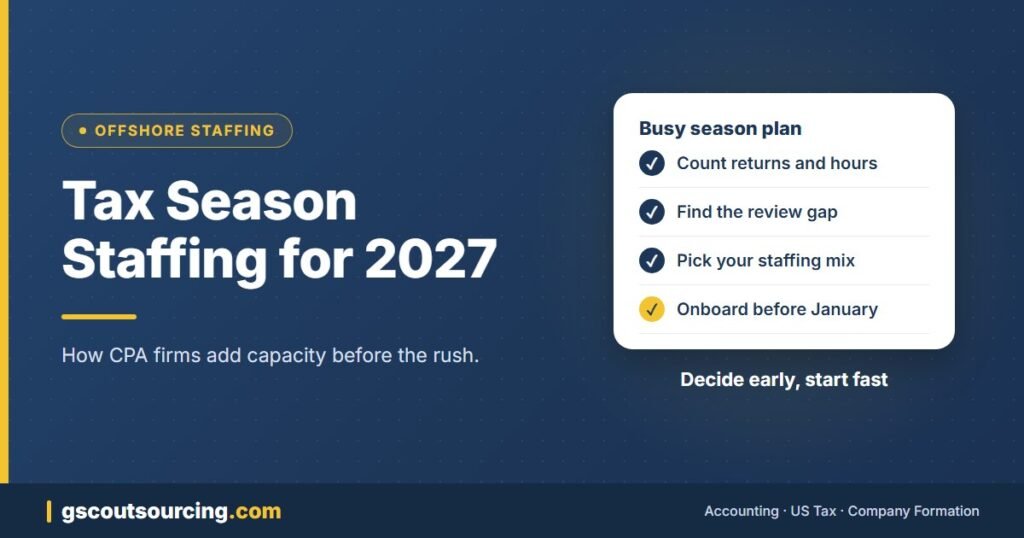
Tax season staffing decisions made now decide how the next five months feel. This guide shows how to size the gap, compare your options and get new people productive before the rush.
Start tax season staffing by counting returns by type and the hours each takes, then compare that with your team's real capacity. Fill the gap with a mix of seasonal hires, contract preparers and offshore staff. Decide by early December, so new people are trained on your software and review process before the first returns arrive in late January.
Quick answers
- When should we plan? Now. Aim to have extra capacity in place by early January.
- Main options? Overtime, seasonal hires, contract preparers, offshore staff, or outsourcing whole batches.
- Biggest bottleneck? Usually review, not preparation.
- Offshore rules? You need Section 7216 consent before data goes abroad.
- Is hiring getting easier? BLS still projects steady demand for accountants.
Why is tax season staffing so hard for CPA firms?
Demand for accountants keeps growing, and the work all lands in the same few months.
The BLS Occupational Outlook Handbook (updated October 29, 2026) projects employment of accountants and auditors to grow 5% from 2025 to 2035, faster than average. It expects about 115,300 openings each year. Every firm is hiring from that same pool, often for the same January start.
Season timing makes it worse. Calendar-year partnership and S corporation returns are due March 15, 2027, and individual and C corporation returns April 15, 2027. Form 7004 gives businesses an automatic 6-month extension, which pushes more work into September and October.
How do you work out how many people you need?
Count returns by type, multiply by honest hours per return, and compare that with the hours your team can actually give.
- List last season's returns by type: 1040, 1065, 1120-S, 1120 and others.
- Add expected new clients and remove those who left.
- Use real hours per return, from time records, not hopes. Split prep from review.
- Work out team capacity after meetings, client calls and admin.
- Find the gap in prep hours and review hours, month by month.
Most firms find the review gap is the painful one. Adding preparers without adding review time just moves the pile to the partner's desk.
What are your tax season staffing options?
Each option trades cost, control and ramp-up time differently. Most firms combine two or three.
| Option | Best for | Watch out for |
|---|---|---|
| Overtime for current staff | Small, short gaps | Burnout and mistakes late in the season |
| Seasonal local hires | Simple 1040s and admin | Training time every year, and a small pool |
| Contract preparers | Short-term prep help | Uneven quality, and your review load grows |
| Offshore dedicated staff | Steady prep, review support and year-round work | Needs 7216 consent, security setup and onboarding |
| Outsourcing return batches | Handing off whole groups of returns | Less day-to-day control of the work |
Offshore staffing typically costs 60-70% less than a comparable local hire. Dedicated staff can also stay after April for extensions, bookkeeping and planning work.
Need more hands before January?
Dedicated offshore staff who work inside your software, with no minimum contract term.
What should be in place before new staff start?
Access, a written workflow and a review checklist. New people slow you down without them.
Before day one
- Software licenses and secure remote access
- A written workflow for each return type
- A prep checklist and a review checklist
- Sample completed returns to learn from
- Section 7216 consents for any offshore work
- Your WISP updated to cover new staff and access
The compliance pieces matter most when staff work outside the US. Our guides to 7216 consent and the WISP for tax preparers cover both.
Want help sizing your 2027 season? Book a free 30-minute call and we'll work through the numbers with you.
How do you get seasonal staff productive fast?
Start them on simple returns, review their first batch closely, and add harder work in steps.
- Week 1: software, workflow and sample returns.
- Weeks 2-3: simple returns, with full review and feedback.
- Weeks 4-6: more complex returns as review notes shrink.
- All season: one point of contact for questions, and a shared list of common review notes.
Teams that start in December reach full speed before the February rush. Teams that start in late February rarely do.
Frequently asked questions
What firm owners ask about busy season capacity.
When should a CPA firm hire for tax season?
Plan in November and have people in place by early January. That leaves time for training and practice returns before late January, when client documents start to arrive in volume. Late hires often add review work instead of saving time.
Is offshore staffing only for tax season?
No. Many firms keep dedicated offshore staff all year for bookkeeping, extensions, planning and payroll work. That keeps trained people in place for the next season and avoids retraining every January.
Do we need client consent to use offshore staff?
Yes. Under Section 7216, you need the taxpayer's written consent before any return information goes to a preparer outside the US, including your own employees. For 1040 clients, SSNs should be masked as well.
How do we keep quality up with new people?
Use written checklists for prep and review, start new staff on simple returns, and review their first batch in full. Keep a shared list of common review notes, so the same mistakes don't repeat across the team.
What does offshore staffing cost compared with a local hire?
Offshore staffing typically costs 60-70% less than a comparable local hire. The real figure depends on the role, experience and hours. Compare the full cost of a local hire, including benefits and recruiting time.
The bottom line
Good tax season staffing starts with honest numbers: returns, hours and the review gap. Pick the mix that fits, whether that is seasonal hires, contract preparers or dedicated offshore staff, and decide early. Have access, checklists and 7216 consents ready before anyone starts.
Get ahead of the 2027 season
GSC Outsourcing provides dedicated staff who join your team and work in your software. A person reviews every output.
Related reading: Why Accounting Firms Are Turning to Offshore Staffing in 2026
