
Your US LLC has money in its bank account from Amazon payouts, Shopify sales or client invoices. Now you want to move some of it home. Can you just send it to yourself? Is it a salary? Does the IRS need to know?
This guide explains how to pay yourself from a US LLC as a non-resident owner, what the IRS expects you to report, and the home-country questions to settle before you transfer.
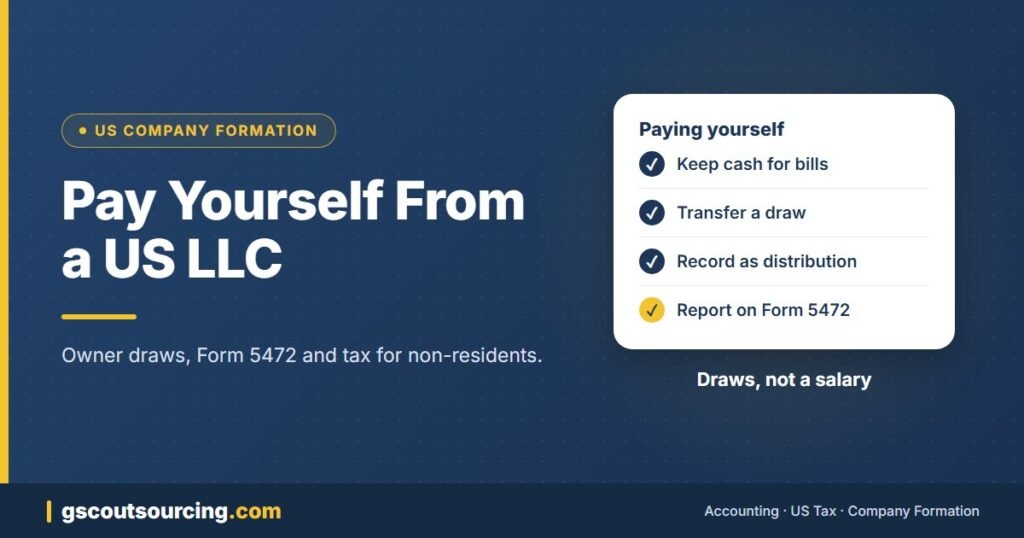
Most non-resident owners of a single-member US LLC pay themselves through owner distributions (also called draws), not a salary. You transfer money from the LLC's bank account to your own account and record it as a distribution. For a foreign-owned single-member LLC, the IRS requires contributions and distributions to be reported on Form 5472. Whether any US tax is due depends on the LLC's income, and your home country will usually tax the profit.
Quick answers
- Salary or draw? A single-member LLC owner usually takes owner draws, not a salary.
- Do I report it? Yes. Distributions are reported on Form 5472 for a foreign-owned single-member LLC.
- Is there US withholding on a draw? Not usually for a disregarded LLC, but it can apply if the LLC is taxed as a corporation.
- Can I pay personal costs from the LLC card? Better not. Transfer a draw, then pay personally.
- What about home-country tax? Check your country's rules on official sources or with a local adviser.
How do you pay yourself from a US LLC as a non-resident?
You take an owner distribution: a transfer from the LLC's bank account to your personal account, recorded in the books as a draw.
- Check the cash. Leave enough in the LLC for upcoming fees, refunds, inventory and taxes.
- Transfer the money. Send it from the LLC's US account to your personal account, by wire or another transfer service your bank supports.
- Record it as a distribution. In the books, it goes to an owner's draw or distribution account, not to an expense.
- Keep the evidence. Save the bank confirmation and a short note of the date, amount and exchange rate.
- Report it at year-end. Include it in the Form 5472 statement (see below) and in your home-country return as your rules require.
Paying yourself regularly is fine. What causes trouble is mixing: paying personal bills straight from the LLC account, or using the LLC card for private spending. Keep the two separate so the books show clear distributions. If you are still setting up, our US company formation guide for non-residents covers the bank account and EIN steps.
Can a non-resident owner take a salary from their LLC?
Not in the usual sense. For income tax, the IRS treats a single-member LLC as part of its owner, so there is no separate employer paying you wages.
The IRS page on single-member LLCs explains that an LLC with one member is "disregarded" for income tax unless it elects to be taxed as a corporation on Form 8832. Its profit belongs to the owner directly. So the owner takes draws from the profit rather than paying themselves a payroll salary.
| How the LLC is taxed | How the owner gets paid | Key US point |
|---|---|---|
| Single-member, disregarded (default) | Owner distributions (draws) | Report distributions on Form 5472 |
| Multi-member, partnership (default) | Partner distributions | Partnership return and partner rules apply |
| Elected to be taxed as a corporation | Dividends, or salary if the owner works for it under US payroll rules | Dividends to foreign persons can face US withholding |
Need your LLC's books and filings handled?
We keep your US company's records clean and file Form 5472 on time every year.
Do you have to report owner distributions to the IRS?
Yes. A foreign-owned single-member LLC reports contributions to and distributions from the LLC on Form 5472.
The IRS Form 5472 instructions (updated April 30, 2026) say that a foreign-owned disregarded entity checks the box in Part V for transactions such as "contributions to, and distributions from, the entity," and describes them on an attached statement. Money you put in to start the business counts too. The penalty for failing to file Form 5472 is $25,000, so track every transfer between you and the LLC during the year.
Our Form 5472 guide explains the full filing, including the pro forma Form 1120 it attaches to.
Is there US tax or withholding when you pay yourself?
The draw itself is usually not a taxable event in the US. The question is whether the LLC's income is taxed in the US at all.
- Disregarded LLC with no US trade or business income. Many non-resident owners with no US staff or office owe no US income tax. Our guide to US LLC taxes for non-residents explains the test.
- Disregarded LLC with US effectively connected income. The owner files a US return and pays tax on that income, whether or not it was distributed.
- LLC taxed as a corporation. Dividends paid to a foreign person are US-source income. The IRS's NRA withholding page says most such income is subject to 30% tax, unless a lower treaty rate applies.
Not sure which applies to your LLC? Book a free 30-minute call and we'll talk through your setup.
What about tax and money rules in your home country?
Your home country usually taxes the LLC's profit, and it may have rules on money coming in from abroad.
Many countries treat a single-member US LLC differently from the IRS. Some tax the profit as it is earned, others when it is paid out, and some treat the LLC as a foreign company. Some also have foreign exchange or reporting rules for overseas businesses. In India, for example, the RBI and FEMA rules apply to overseas investments. Check your country's rules on official sources, or with a local adviser, before you set up regular transfers.
AI bookkeeping tools can spot transfers from the LLC account to you and suggest coding them as distributions. A person should still confirm each one, because the totals go on your Form 5472 statement.
Frequently asked questions
What non-resident founders ask about taking money out of a US LLC.
How often can I pay myself from my LLC?
As often as you like, as long as the LLC keeps enough cash to pay its bills and taxes. Many owners take a fixed monthly draw. Record each one and keep the bank confirmation for your year-end filings.
Is an owner's draw a business expense?
No. A draw is a transfer of profit to the owner, not a cost of running the business. It goes to an owner's equity account and doesn't reduce the LLC's profit.
Can I pay my personal expenses with the LLC's card?
It is better not to. Mixing personal and business spending makes the books harder to keep and can weaken the separation between you and the LLC. Take a draw and pay personal costs from your own account.
Do I need to report the money I put into the LLC?
Yes. The Form 5472 instructions list contributions to the entity, as well as distributions from it, as reportable transactions for a foreign-owned disregarded LLC. That includes the money you put in to open the bank account or buy first stock.
Will my bank ask why I'm sending money abroad?
Banks may ask about large or unusual transfers. Keep your formation documents, EIN letter and books ready, and describe the transfer as an owner distribution. Each bank applies its own checks.
The bottom line
As a non-resident owner of a single-member US LLC, you pay yourself through owner distributions, not a salary. Transfer from the LLC account, record each draw, and report contributions and distributions on Form 5472. Check whether the LLC has US-taxable income, and settle your home-country tax and money rules before you set up regular transfers.
Keep your US LLC clean and compliant
Talk to a GSC Outsourcing partner about your books, distributions and yearly filings. Check this month's founder welcome offer on our formation page.
Related reading: Form 5472 for Foreign-Owned US LLCs: Who Files, When and How to Avoid the $25,000 Penalty
