
Your US company pays the salaries of a team that works for your Indian subsidiary. The parent lends money to a new entity in Europe. One company sells stock to another before it reaches customers. Each of these is a real transaction for one entity, and invisible to the group as a whole.
That gap is what intercompany accounting deals with. This guide explains what it is, how the entries and eliminations work, and why software built for it saves the most time at month-end.
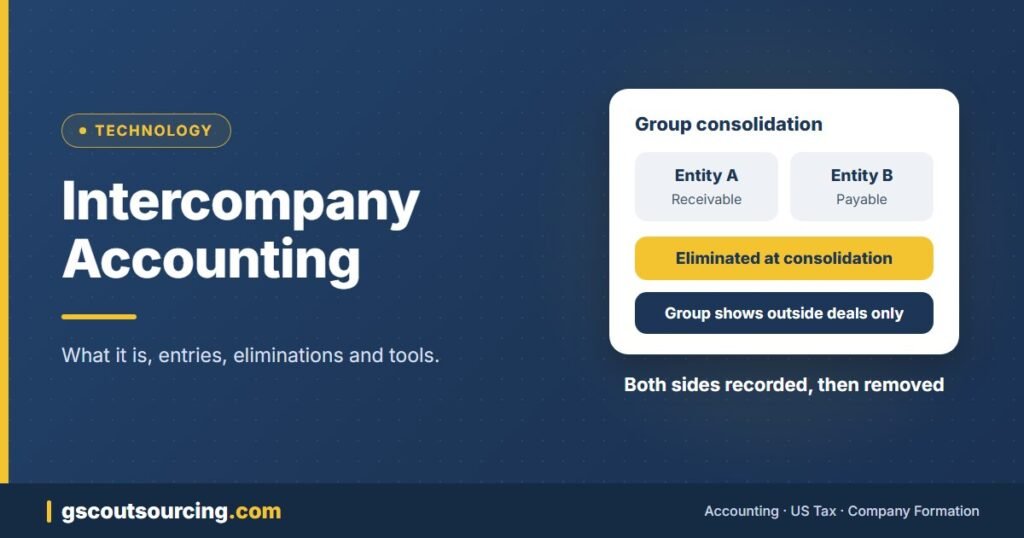
Intercompany accounting is the recording of transactions between entities that belong to the same group, such as loans, shared costs or sales between a parent and its subsidiaries. Each entity books its side, both sides must agree, and at consolidation the balances are eliminated so the group's statements show only dealings with outside parties. SoftLedger automates the intercompany entries and eliminations in one multi-entity ledger.
Quick answers
- What counts as intercompany? Any transaction between two entities in the same group.
- Why eliminate it? So the group doesn't show sales, profit or debt it owes to itself.
- What goes wrong most? The two sides don't match, often due to timing or currency.
- Who needs it? Any business with two or more legal entities that trade with each other.
- How does software help? It books both sides at once and eliminates them automatically.
What is intercompany accounting?
It is the process of recording, matching and eliminating transactions between companies in the same group.
Each company keeps its own books. When two of them deal with each other, both record it. One has money owed to it and the other owes the money. Or one books a sale and the other a cost. For each company's own books and tax return, those entries are real.
For the group, they are not. A parent can't make a profit by selling to its own subsidiary. So when the group adds up its results, the matching amounts are taken out. That step is called an elimination.
What are common intercompany transactions?
Loans, shared costs, management fees and sales of goods or services between group companies.
| Transaction | Entity A records | Entity B records | Eliminated at consolidation |
|---|---|---|---|
| Intercompany loan | Loan receivable, interest income | Loan payable, interest expense | The receivable against the payable, income against expense |
| Shared costs recharged | Receivable, reduced expense | Payable, expense | The receivable against the payable |
| Management fee | Fee revenue | Fee expense | Revenue against expense |
| Sale of inventory | Revenue, cost of sales | Inventory | The sale and any unrealized profit still in inventory |
How do intercompany eliminations work?
At consolidation, you reverse the matching balances on both sides so they net to zero.
- Record both sides. Each entity books its part of the transaction, ideally with the same reference.
- Reconcile. Check that A's receivable equals B's payable, in the same currency, at the same date.
- Fix differences. Timing gaps, missing invoices and exchange-rate differences are the usual causes.
- Eliminate. Remove the matching balances, plus any unrealized profit on goods still held in the group.
- Consolidate. Combine what's left into the group's balance sheet, income statement and cash flow.
Done by hand, steps 2 and 3 take the most time. The two sides often sit in different systems or files.
Eliminations fix the group's statements, but each company's own tax return still counts the deal. The IRS transfer pricing page (updated February 27, 2026) says Section 482 lets the IRS adjust income between companies under common control. Prices between group companies should match what unrelated parties would agree.
Is your group close slowed by intercompany?
Our Accounting Advisory team maps your entities and sets up a cleaner process.
Why is intercompany accounting hard in a single-entity system?
Because each company lives in its own file, so matching and eliminating happens outside the books.
In QuickBooks Online, an answer on Intuit's QuickBooks Community (checked November 23, 2026) explains that each company you create needs its own subscription, and you switch between companies under one sign-in. That works well for a single business. For a group, it means each entity's intercompany balances are reviewed company by company, and the eliminations and consolidated reports are usually built in a spreadsheet.
Software built for several companies works differently. It knows which ones belong to the group. So it can record both sides at once and take them out when it builds the reports. Our guide to multi-entity accounting software covers what to look for.
How does SoftLedger handle intercompany accounting?
SoftLedger runs every entity in one ledger, so intercompany entries and eliminations happen inside the system, in real time.
According to SoftLedger's consolidation page and multi-entity page, checked on November 23, 2026, it offers:
- Intercompany journal entries between entities in the same platform.
- Automatic eliminations. Intercompany receivables, payables and revenue are identified and eliminated in real time.
- Currency handling. Transactions between entities in different currencies are translated and eliminated during consolidation.
- Consolidated reporting at any level, for one entity, a region or the whole group, with drill-down to the original transaction.
- Any structure, including subsidiaries, divisions, joint ventures and holding companies, with each entity keeping its own books.
The result is that the matching and elimination steps stop being a month-end project. See our SoftLedger vs QuickBooks comparison for the wider picture.
How does AI help with intercompany accounting?
AI can flag intercompany items that don't match and suggest the likely cause, but a person still approves the eliminations.
AI tools can scan both companies' books for missing or mismatched entries, such as a bill booked in one company but not the other. They can also draft notes on the gaps for a person to check. The accountant still decides how to treat them, mainly for profit left in stock and exchange-rate gaps. Our AI month-end close guide shows where this fits.
Not sure your intercompany process will hold up as you add entities? Book a free 30-minute call and we'll review it with you.
Frequently asked questions
What finance teams ask about intercompany accounting.
What is the difference between intercompany and intracompany?
Intercompany transactions happen between separate legal entities in the same group, such as a parent and a subsidiary. Intracompany transactions happen inside one legal entity, such as between two departments or locations. Only intercompany balances need eliminating at consolidation.
What is an intercompany elimination entry?
It is a consolidation entry that removes matching intercompany balances, such as a receivable in one entity and the payable in another. After elimination, the group's statements show only transactions with outside parties.
Why don't intercompany balances match?
The usual causes are timing (one side booked before the other), missing invoices, different exchange rates and coding errors. Agreeing balances every month, rather than at year-end, keeps differences small.
Do small groups need intercompany accounting?
Yes, as soon as two entities trade, lend or share costs. Even a founder with a US LLC and a company at home may have intercompany balances that need recording on both sides.
Can SoftLedger eliminate intercompany transactions automatically?
Yes. SoftLedger says it finds and removes intercompany receivables, payables and revenue in real time. This works even when the two entities use different currencies, so there is no month-end spreadsheet to build.
The bottom line
Intercompany accounting records the dealings between group companies on both sides, then removes them so the group's results are real. The hard part is matching the two sides every month. SoftLedger keeps all entities in one ledger and eliminates intercompany balances automatically, which turns a month-end project into a routine check.
Close your group's books faster
GSC Outsourcing's accountants handle intercompany entries, reconciliations and consolidation inside your systems. A person reviews every output.
Related reading: Multi-Entity Accounting Software: What a Growing Group Needs
