
A business that holds or pays in crypto soon finds out that a spreadsheet of wallet balances isn't accounting. Every transfer, swap and payment has a cost basis, a gain or loss, and a place in the financial statements. Multiply that by several wallets, exchanges and entities, and month-end stops closing on time.
This guide explains what crypto accounting software has to do for a business in 2026, the rules driving it, and how SoftLedger handles digital assets inside its general ledger.
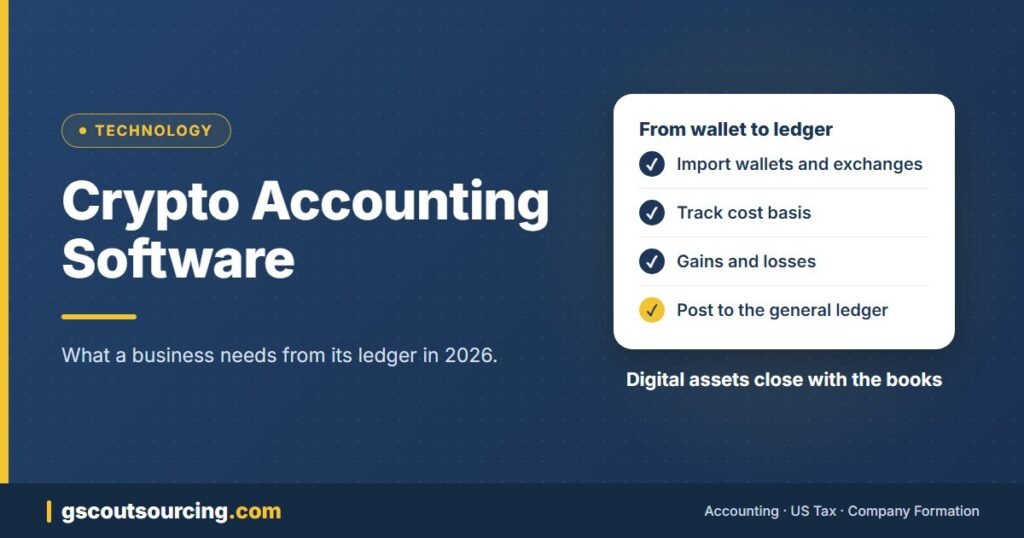
Crypto accounting software imports transactions from wallets and exchanges, tracks cost basis, calculates realized and unrealized gains and losses, and posts the results to your general ledger. Since ASU 2023-08, most US businesses measure in-scope crypto at fair value through net income. SoftLedger builds this into its general ledger, with multi-entity and multi-currency reporting in the same system.
Quick answers
- Why not a spreadsheet? Cost basis and gains must be tracked per transaction, which breaks down at volume.
- What changed in GAAP? ASU 2023-08 requires in-scope crypto assets at fair value, with changes in net income.
- What does the IRS say? Digital assets are property, and brokers now report on Form 1099-DA.
- What should software do? Import data, track basis, calculate gains and losses, and post to the ledger.
- Where does SoftLedger fit? It has a native crypto module inside a multi-entity general ledger.
What does crypto accounting software do?
It turns raw wallet and exchange activity into ledger entries your accountant can close and audit.
A good tool covers four jobs:
- Import. Pull transactions from exchanges and blockchains, so nobody re-types them.
- Track basis. Record what each unit cost, and follow it through transfers between wallets.
- Calculate gains and losses. Work out realized gains on each disposal and unrealized gains at each reporting date.
- Report. Post the results to the general ledger and roll them into the financial statements.
Tools that only do the first three leave you exporting reports and booking journal entries by hand. The real time saving comes when the crypto activity and the ledger live in one place.
What accounting rules apply to crypto in 2026?
Under US GAAP, ASU 2023-08 moved in-scope crypto assets to fair value. For tax, the IRS treats digital assets as property.
| Rule | What it requires | What your software must support |
|---|---|---|
| FASB ASU 2023-08 | Measure in-scope crypto assets at fair value each reporting period, with changes in net income; present them separately on the balance sheet | Live or period-end prices and remeasurement entries |
| IRS: digital assets are property | Gains and losses on each sale, exchange or payment; basis is generally the cost in US dollars | Transaction-level cost basis and realized gains |
| Form 1099-DA | Brokers report gross proceeds for transactions from January 1, 2025, and basis on certain transactions from January 1, 2026 | Records you can reconcile to the forms you receive |
The FASB's ASU 2023-08 took effect for fiscal years beginning after December 15, 2024. The broker reporting dates come from the IRS digital assets page, which we checked on November 23, 2026.
How does SoftLedger handle crypto accounting?
SoftLedger is a general ledger with a native module for crypto assets, so digital asset activity flows straight into the books.
SoftLedger describes itself as the first general ledger with a native crypto module. According to its crypto accounting software page, checked on November 23, 2026, it:
- Imports transactions from crypto exchanges and blockchains, for assets such as Bitcoin, Ethereum, Solana, Avalanche and Cardano.
- Calculates realized and unrealized gains and losses automatically, with transaction-level detail.
- Tracks cost basis using FIFO or specific identification, including transfers between wallets and exchanges.
- Reconciles crypto balances as of past dates.
- Reports in fiat or crypto, across multiple wallets and entities.
- Links on-chain transactions to block explorers using hash IDs.
- Offers a programmable API for custom integrations.
Because this sits inside the same ledger as AP, AR and reporting, there is no separate crypto system to reconcile at month-end. You can drill from a report down to the underlying transaction.
Choosing a ledger that handles crypto?
Our Accounting Advisory team helps you map your process before you pick a system.
Why does multi-entity support matter for crypto?
Crypto businesses often run several entities and currencies, and the crypto data has to consolidate with everything else.
A fund, a protocol foundation or a trading business may hold wallets in different companies and countries. SoftLedger's consolidation features run many entities in one platform, eliminate intercompany balances automatically and translate foreign-currency entities into the reporting currency under GAAP or IFRS. Crypto activity uses the same dimensions, so a consolidated report includes digital assets without a separate spreadsheet.
Our guides to multi-entity accounting software and multi-currency accounting software cover those features in more detail.
How does AI help with crypto accounting?
AI can sort high volumes of on-chain activity and flag odd items, but a person still decides the accounting treatment.
AI-assisted tools can suggest categories for transactions, spot transfers between your own wallets so they aren't booked as sales, and flag unusual amounts for review. Questions such as whether an asset is in scope for ASU 2023-08 still need an accountant. Software with an open API, like SoftLedger, also makes it easier to connect AI-assisted review tools to the ledger.
Frequently asked questions
What finance teams ask when they choose crypto accounting software.
What is the best crypto accounting software for a business?
Look for software that imports from your exchanges and wallets, tracks cost basis per transaction, calculates gains and losses, and posts to your general ledger. If you run several entities or currencies, consolidation in the same system matters too. SoftLedger covers all of these in one platform.
How do businesses account for crypto under GAAP?
Under ASU 2023-08, in-scope crypto assets are measured at fair value each reporting period, with changes recognized in net income. They are shown separately from other intangible assets. Your auditor will confirm which of your assets are in scope.
Is crypto taxed as property in the US?
Yes. The IRS treats digital assets as property, not currency. Each sale, exchange or payment with crypto can create a gain or loss, measured against its cost basis in US dollars.
What is Form 1099-DA?
It is the form brokers use to report digital asset transactions. The IRS says gross proceeds are reported for transactions from January 1, 2025, and basis for certain transactions from January 1, 2026.
Can SoftLedger handle multiple wallets and entities?
Yes. SoftLedger says it manages multiple wallets and entities and reports in fiat or crypto, with consolidation across entities in the same platform. Transfers between your own wallets and exchanges keep their cost basis, so they aren't booked as sales.
The bottom line
Crypto accounting software should do more than total up wallet balances. It needs to import data, track basis, calculate gains and losses at fair value and post the results to the ledger. SoftLedger does this natively, inside a multi-entity general ledger, so digital assets close with the rest of the books.
Get your crypto books audit-ready
GSC Outsourcing's accountants work inside your systems and keep the books current. A person reviews every output.
Related reading: SoftLedger vs QuickBooks: Why Multi-Entity Businesses Switch · What Is Intercompany Accounting? Entries, Eliminations and Tools
