
Most businesses don't plan to become a group. It happens one step at a time: a second LLC for a new product line, a holding company, a property entity, a subsidiary abroad. Each step adds another set of books, and the accounting system that worked for one company starts to strain.
This guide explains what multi-entity accounting software should do, the signs you need it, and how SoftLedger handles each requirement.
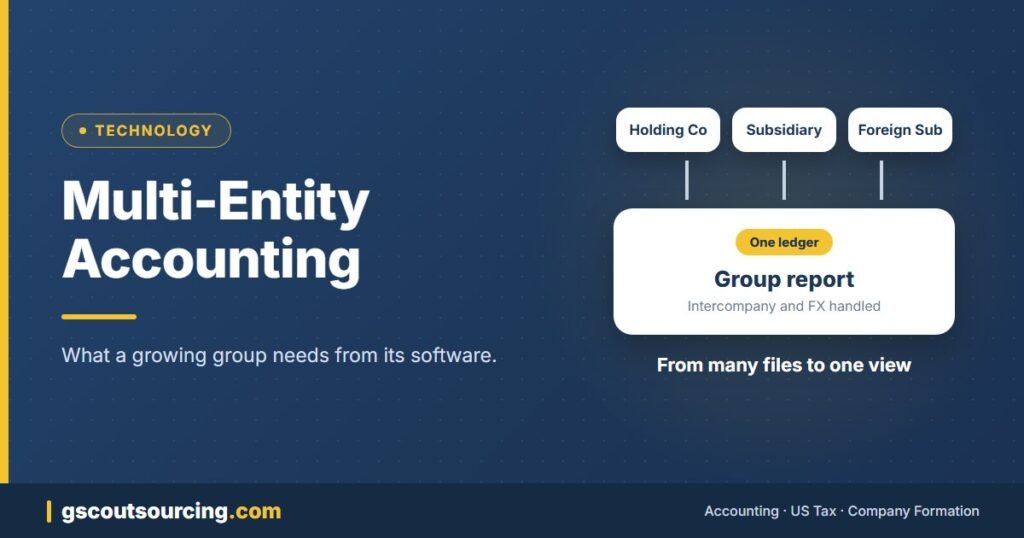
Multi-entity accounting software keeps the books for several legal entities in one system and rolls them up into consolidated reports. The features that matter most are real-time consolidation, automatic intercompany eliminations, multi-currency translation, one shared chart of accounts and an open API. SoftLedger is built around a multi-entity general ledger that does all of these natively.
Quick answers
- What is it? One accounting system for many legal entities, with group reporting built in.
- Who needs it? Businesses with two or more entities, foreign subsidiaries or a holding structure.
- Most important feature? Consolidation that runs inside the ledger, not in a spreadsheet.
- What about intercompany? Good software eliminates intercompany balances automatically.
- Where does SoftLedger fit? It was designed for multi-entity, multi-currency accounting from the start.
What is multi-entity accounting software?
It is accounting software that records transactions for several separate companies in one ledger and produces reports for each entity and for the group as a whole.
Each entity still has its own books, bank accounts and tax filings. The difference is that they live in one system with a shared structure, so the software can roll them up, eliminate what the entities owe each other, and show the group's real position.
Without it, finance teams usually keep one file per company, export reports from each, and consolidate in spreadsheets. That works for two small entities. It gets slow and error-prone as the group grows.
What are the signs you need multi-entity accounting software?
If consolidation is a spreadsheet project every month, or you can't see the group's numbers until well after close, it's time.
Signs you've outgrown single-entity books
- You log in and out of separate company files to close each month
- Group reports are built by exporting and combining spreadsheets
- Intercompany loans and charges don't match between entities
- A foreign subsidiary's books are translated by hand
- Adding a new entity means setting up a new system from scratch
- Leadership waits weeks for consolidated numbers
If several of these sound familiar, the issue is the structure of your system, not the effort of your team. Our guide to how AI is changing month-end close covers what a faster close looks like.
Which features matter most in multi-entity accounting software?
Consolidation, intercompany, currency, structure and connectivity. Here is what to look for in each, and how SoftLedger handles it.
| Feature | What to look for | How SoftLedger handles it |
|---|---|---|
| Consolidation | Group reports at any time, not only after close | Real-time consolidated P&L, balance sheet and cash flow, with drill-down to the source transaction |
| Intercompany | Automatic matching and elimination | Intercompany receivables, payables and revenue identified and eliminated as transactions post |
| Multi-currency | FX rates and translation to a reporting currency | FX rates pulled per transaction; remeasurement and translation under GAAP or IFRS |
| Structure | Any mix of subsidiaries, divisions and holding companies | Models subsidiaries, divisions, joint ventures and holding companies in one ledger |
| Growth | New entities without a new system | New entities added without disrupting existing workflows or reports |
| Connectivity | A documented API and integrations | API-first platform with open documentation |
These capabilities are described on SoftLedger's multi-entity accounting and consolidation pages, which we checked on November 17, 2026.
Why does intercompany accounting get easier in one ledger?
Because both sides of every intercompany transaction sit in the same system, so the software can match and eliminate them instead of a person reconciling two files.
When entities keep separate books, a loan from the parent to a subsidiary is booked twice, by two people, often on different days and at different rates. At month-end someone has to find the gaps.
A 2016 Journal of Accountancy article says this kind of matching and elimination can take a lot of time and staff. It advises clear trading-partner data and tools that match deals between entities.
- In one ledger, SoftLedger identifies intercompany balances and eliminates them during consolidation.
- Across currencies, it translates cross-currency intercompany balances before eliminating them.
- The result is a consolidated report that doesn't double-count revenue, receivables or payables.
Setting up a multi-entity ledger?
Our Accounting Advisory team designs your entity structure, chart of accounts and intercompany rules.
How do you choose and roll out multi-entity accounting software?
Start from your group structure and reporting needs, then plan the data move and run a parallel close before you switch.
- Draw the group. Every entity, its owner, currency and reporting line.
- List what leadership needs to see: consolidated statements, segment reports, cash by entity.
- Agree one chart of accounts that works for every entity.
- Plan the import. SoftLedger supports bringing in data from QuickBooks, Xero, NetSuite and other systems.
- Set intercompany and FX rules before the first close.
- Run one parallel close and tie the consolidated numbers to your old reports.
Switch at a clean period end, such as a quarter or year-end. It makes opening balances easier to prove and keeps comparisons simple for your auditors.
Need help running the books once the new system is live? Our Client Accounting Services team works inside your own software.
Frequently asked questions
Straight answers to what finance leaders ask about multi-entity accounting.
What is the difference between multi-entity and multi-company accounting?
The terms are often used the same way. Both mean keeping books for several legal entities. What matters is whether the software keeps them in one ledger with consolidation built in, or in separate files you combine yourself.
Does SoftLedger handle consolidation automatically?
Yes. SoftLedger consolidates in real time as transactions are recorded and eliminates intercompany balances automatically. You can report by entity, region or the whole organization.
Can multi-entity software handle foreign subsidiaries?
Good systems can. SoftLedger pulls FX rates at transaction level and supports remeasurement and translation of foreign-currency entities to your reporting currency under GAAP or IFRS.
How many entities can SoftLedger hold?
It depends on the plan. SoftLedger's pricing page lists entity limits on its entry plans and unlimited entities on its higher tiers. Pick a plan with room for the entities you expect to add next.
Is multi-entity software only for large companies?
No. Many growing businesses reach two or three entities early, for example an operating company plus a holding or property company. Moving before the group gets complicated is usually easier than moving later.
The bottom line
Multi-entity accounting software earns its place when consolidation, intercompany and currency work move out of spreadsheets and into the ledger. SoftLedger was built for exactly that, with real-time consolidation, automatic eliminations and multi-currency translation in one system. Plan the structure first and the switch is straightforward.
Bring your entities into one ledger
GSC Outsourcing helps growing groups plan the move to a multi-entity system. Our team then keeps every entity's books current inside it.
Related reading: Cash vs. Accrual Accounting: Which Basis Fits Your Growing Business? · Multi-Currency Accounting Software: What to Look For in 2026
