
Texas comes up often when founders abroad pick a state for their US company. It has no state personal income tax, a large market, and many Amazon and Shopify sellers ship inventory there. But a Texas LLC has its own yearly report, and the rules differ from Wyoming or Delaware.
This guide explains how to form an LLC in Texas as a non-resident owner, what it costs at the state, and what you must file every year after that.
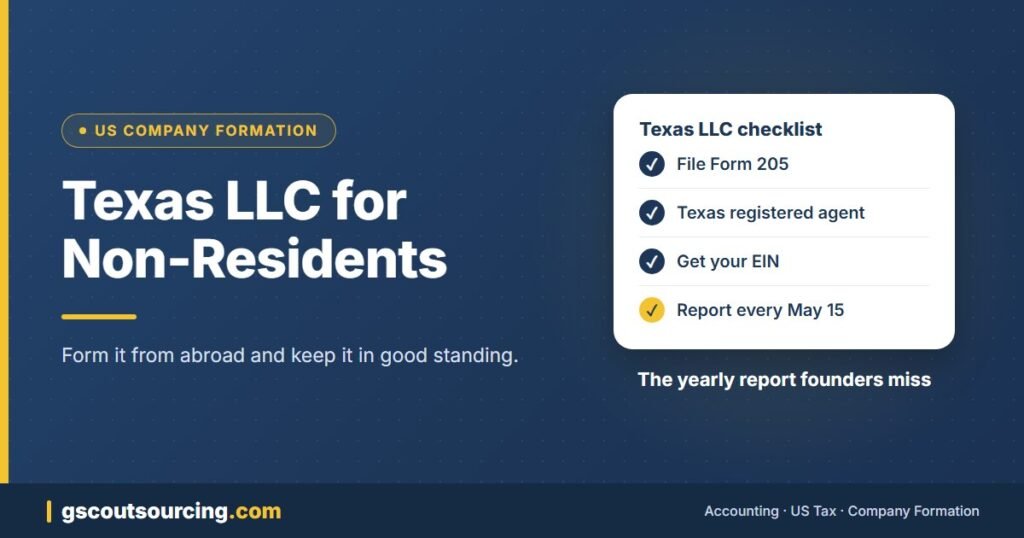
A non-resident can form a Texas LLC by filing Form 205, the Certificate of Formation, with the Texas Secretary of State. The state filing fee is $300, and you need a registered agent with a street address in Texas. Every year the LLC files a franchise tax Public Information Report by May 15, and it owes franchise tax only if revenue is above the no-tax-due threshold ($2.65 million for 2026 and 2027 reports).
Quick answers
- Can a non-resident own a Texas LLC? Yes. Texas has no residency or citizenship rule for LLC members.
- What does the state charge to form one? $300 for the Certificate of Formation (Form 205).
- Is there a yearly report? Yes, a franchise tax Public Information Report, due May 15.
- Do small LLCs pay franchise tax? Not if annualized revenue is at or below the no-tax-due threshold.
- Do I still file with the IRS? Yes. A foreign-owned single-member LLC files Form 5472 every year.
Can a non-resident form a Texas LLC?
Yes. You don't need to live in Texas, hold a US visa or have a Social Security number to form a Texas LLC.
What you do need is a registered agent in Texas. The Texas Secretary of State's Form 205 instructions say the agent can be a Texas resident or a business registered in Texas. The LLC can't act as its own agent. The agent's address must be a street address where legal papers can be delivered in person, not just a mailbox service. Our guide on what a registered agent does explains the role.
The certificate must also say whether the LLC has managers. If it does, you list each initial manager. If it doesn't, you list each initial member. At least one person must be named.
How do you form an LLC in Texas step by step?
Pick a name, appoint a registered agent, file Form 205 with the state, then get an EIN and set up your accounts.
- Choose a name. It must include "limited liability company", "limited company" or an abbreviation such as LLC. The Secretary of State decides if the name is available when it reviews your filing.
- Appoint a registered agent. The agent must agree to serve before you name them.
- File Form 205. File online through SOSDirect or send the form to the Secretary of State with the $300 fee.
- Write an operating agreement. Texas doesn't file it, but banks and payment providers often ask for one.
- Get an EIN. Apply to the IRS once the state approves the LLC. Our EIN guide for non-residents walks through Form SS-4.
- Open bank and payment accounts. Approval is always at the bank's or provider's discretion.
Each step is simple on its own, but the order matters and a mistake on the form can delay everything. Book a free 30-minute call and we'll check your plan before you file.
What does a Texas LLC cost each year?
The state charges $300 to form the LLC. After that, most small LLCs pay no franchise tax, but they must still file a report every year.
The Texas Comptroller's franchise tax page sets the numbers. We checked them on November 23, 2026:
| Item | 2026 and 2027 reports | What it means for you |
|---|---|---|
| No-tax-due threshold | $2,650,000 | At or below this annualized revenue, no franchise tax is owed |
| Tax rate (retail or wholesale) | 0.375% | Applies to the taxable margin above the threshold |
| Tax rate (other businesses) | 0.75% | Applies to most service and non-retail LLCs |
| Report due date | May 15 | Next business day if May 15 falls on a weekend or holiday |
| Late filing penalty | $50 per report | Charged on each report filed after the due date |
Since the 2024 report year, an entity at or below the threshold doesn't file a No Tax Due Report. The Comptroller says it must still file Form 05-102, the Public Information Report, every year. That report is the one founders abroad most often miss.
Want your Texas LLC set up for you?
We form the LLC, act as your US contact and keep every yearly filing on time.
Does a Texas LLC have to collect sales tax?
Only on taxable sales, and marketplaces collect it for you on the sales they process.
Texas charges a 6.25% state sales tax, and local areas can add up to 2%, for a combined maximum of 8.25%, according to the Comptroller's sales tax page. The rules that matter most to online sellers are:
- Marketplace sales. Marketplace providers such as Amazon must collect and remit Texas sales tax on all third-party sales they process.
- Your own website. A seller with no physical presence in Texas doesn't need a permit until Texas revenue reaches $500,000 in the past 12 months.
- Inventory in Texas. Stock in a Texas warehouse can count as physical presence. Check the Comptroller's rules before you send inventory there.
Forming the LLC in Texas is not the same as owing Texas sales tax on every sale. Our guide to ecommerce sales tax for non-US sellers covers the other states.
What federal filings does a foreign-owned Texas LLC need?
The same as in any other state: a foreign-owned single-member LLC files Form 5472 with a pro forma Form 1120 every year, even with no income.
The state you choose doesn't change the federal rules. The IRS penalty for not filing Form 5472 is $25,000. Our Form 5472 guide covers who files and how. Your home country may also tax the LLC's profits, so check its rules on official sources or with a local adviser.
AI bookkeeping tools can read marketplace payout reports and suggest how to split sales, fees and refunds. A person still needs to check the result, because the figures feed your Form 5472 and the Texas revenue test.
Is Texas a good state for a non-resident LLC?
Texas suits founders who sell or hold stock in Texas, or who want a large-state address. For a pure online business with no Texas ties, Wyoming or New Mexico can be simpler.
- Texas works well if you plan a Texas warehouse, staff or partners, or you want your company registered where you do business.
- Compare first if you have no Texas presence. A Texas LLC that operates in another state may also need to register there, which adds a second set of fees.
Our Wyoming vs Delaware comparison and the US company formation guide for non-residents cover the other common choices.
Frequently asked questions
What founders abroad ask before they form a Texas LLC.
How much does it cost to form a Texas LLC?
The Texas Secretary of State charges $300 to file the Certificate of Formation (Form 205). You will also pay for a registered agent unless you have one in Texas. There is no separate state fee for the yearly Public Information Report.
Does Texas have an annual report for LLCs?
Texas doesn't call it an annual report, but LLCs file a franchise tax Public Information Report every year by May 15. LLCs above the no-tax-due threshold also file a full franchise tax report and pay the tax.
Can I be my own registered agent in Texas from abroad?
No. The agent must be a Texas resident or a business registered in Texas, with a street address where legal papers can be served in person. The LLC can't be its own agent, so non-residents use an agent service.
Do I need to visit Texas to form an LLC?
No. You can file Form 205 online or by mail, apply for the EIN from abroad and handle the yearly reports online. Some banks may still ask to verify your identity, and approval is at the bank's discretion.
Is a Texas LLC taxed in Texas if I live abroad?
Texas has no state personal income tax. The LLC owes franchise tax only if its revenue is above the no-tax-due threshold. Federal filings and your home-country tax apply separately.
The bottom line
A Texas LLC is easy to form from abroad: file Form 205 for $300, appoint a Texas registered agent and get an EIN. The part founders forget is the yearly Public Information Report due May 15, plus the federal Form 5472. Choose Texas when you have real business there, and compare simpler states when you don't.
Form your Texas LLC with a partner's help
Talk to a GSC Outsourcing partner about the right state and the filings that follow. Check this month's founder welcome offer on our formation page.
Related reading: Wyoming vs Delaware LLC for Non-Residents: Which State to Choose · How to Pay Yourself From a US LLC as a Non-Resident Owner
