
The US has no national sales tax. Instead, most states and many cities set their own, each with its own rules. For a seller outside the US, that raises an obvious question: do I have to charge sales tax on orders to US customers, and if so, where?
This guide explains how ecommerce sales tax works for non-US sellers on Amazon, Etsy, Shopify and their own websites, and what to check before you reach a state's threshold.
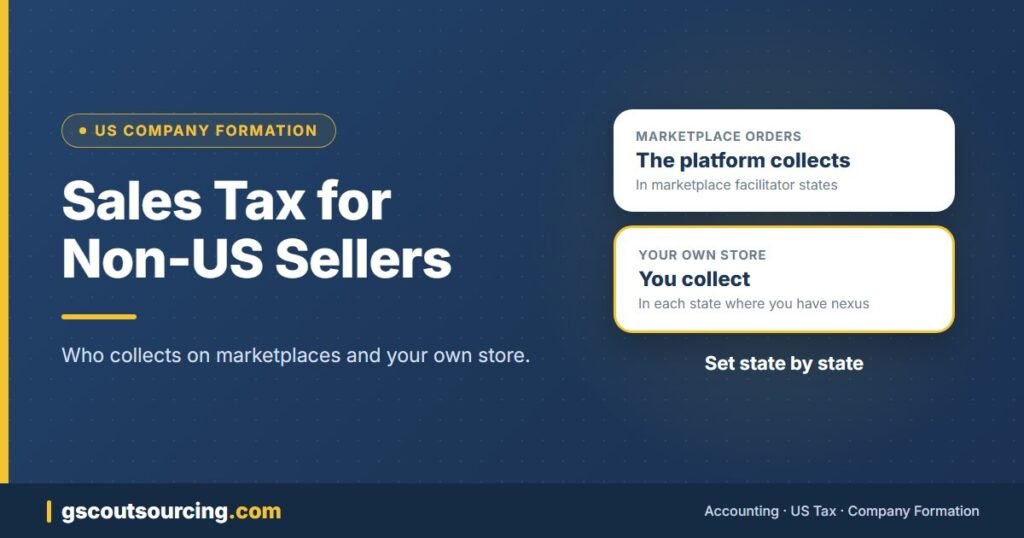
US ecommerce sales tax is set state by state. On marketplaces such as Amazon and Etsy, the platform usually collects and pays the tax in states with marketplace facilitator laws. On your own store, you become responsible in a state once you have nexus there, either by passing its economic threshold or by having a presence such as stored inventory. Then you register, collect and file in that state.
Quick answers
- Is there a US federal sales tax? No. Sales tax is set by states and local governments.
- How many states have it? 45 states and DC have a statewide sales tax.
- Who collects on Amazon orders? Amazon, in states with marketplace facilitator laws.
- Who collects on my Shopify store? You, in each state where you have nexus.
- Do non-US sellers have to follow the rules? Yes. States apply them to remote sellers wherever they are based.
How does ecommerce sales tax work in the US?
Each state decides what is taxable, at what rate, and which sellers must collect. Sellers collect from the customer at checkout and pay it to the state.
According to the Tax Foundation's 2026 sales tax data, 45 states and the District of Columbia collect a statewide sales tax. Alaska, Delaware, Montana, New Hampshire and Oregon do not, although Alaska allows local sales taxes. Many states also add city and county taxes on top of the state rate.
Sales tax is paid by the customer but collected by the seller. If you are required to collect and don't, the state can come to you for the tax you should have charged.
Who collects sales tax: the marketplace or you?
It depends on where the sale happens. Marketplaces generally handle it for you; your own store does not.
| Where you sell | Who usually collects | What you still do |
|---|---|---|
| Amazon | Amazon, in states with marketplace facilitator laws | Check whether any state still expects you to register |
| Etsy and similar marketplaces | The marketplace, in states with marketplace facilitator laws | Keep records of marketplace sales by state |
| Your own Shopify or website store | You | Track nexus, register, collect and file in each state |
| Wholesale to US retailers | Usually no tax if the buyer gives a valid resale certificate | Collect and keep the certificates |
Amazon explains its role on its Marketplace Tax Collection page. Our guide to the Amazon seller account for non-residents covers the rest of the setup.
What is economic nexus for online sellers?
Economic nexus means a state can require you to collect its sales tax once your sales into that state pass its threshold, even with no physical presence there.
This rule comes from the US Supreme Court's decision in South Dakota v. Wayfair on June 21, 2018. The Court upheld a South Dakota law that applied to sellers with more than $100,000 in sales or 200 or more separate transactions into the state in a year. Since then, states have adopted their own thresholds, and they are not all the same.
- Thresholds differ by state. Many use a sales amount, some also use a transaction count.
- What counts differs. Some states count marketplace sales toward your threshold, others don't.
- Physical presence still counts. Inventory stored in a state, including in a fulfillment warehouse, can create nexus there.
Our guide to sales tax nexus explains the types of nexus in more detail.
Selling to US customers from abroad?
We set up your US LLC and EIN, and help you plan the filings that come with it.
When does a non-US seller have to register for sales tax?
When you have nexus in a state and sell taxable goods there through a channel where you, not a marketplace, are the one collecting.
- Map your sales by state and channel every month: marketplace, own store, wholesale.
- Compare own-store sales with each state's threshold, using the state revenue department's website.
- Check where your inventory sits, including third-party warehouses and fulfillment centers.
- Register before you collect. States require a permit before you charge their tax.
- Turn on tax collection for that state in your store's checkout settings.
- File and pay on the schedule the state assigns, even in months with no sales where the state requires it.
Selling through your own store and not sure which states you've reached? Book a free 30-minute call and we'll look at your numbers with you.
Does a US LLC change your sales tax position?
No. Sales tax nexus depends on where you sell and store goods, not on whether the seller is a US LLC or a foreign business.
A US LLC can make registration easier, because state forms often ask for an EIN and a US address. But it does not create or remove nexus by itself. A foreign business selling the same amount into a state faces the same rules. Sales tax is also separate from US income tax: our guide to US LLC taxes for non-residents covers that side.
Frequently asked questions
Straight answers to what non-US online sellers ask about US sales tax.
Do I charge sales tax if I only sell on Amazon?
In states with marketplace facilitator laws, Amazon calculates, collects and remits the tax on your orders. Some states may still expect sellers to register in certain cases, such as when inventory is stored there, so check each state where your stock sits.
Do I charge sales tax on orders shipped from outside the US?
If you have nexus in the customer's state and the product is taxable there, generally yes, wherever you ship from. Separately, imports can carry customs duties, which are a different system.
Is VAT the same as US sales tax?
No. VAT is charged at each stage of the supply chain under national rules. US sales tax is charged once, on the final sale, under state rules, and rates vary by state and city.
What happens if I don't collect sales tax when I should?
The state can assess the tax you should have collected, plus penalties and interest. Many states offer voluntary disclosure programs for sellers who come forward first.
Do digital products have sales tax?
Some states tax digital goods and software, others don't. Check the rules in each state where you have nexus.
The bottom line
Ecommerce sales tax in the US runs state by state. Marketplaces handle most of it for marketplace orders. Your own store is your responsibility once you reach a state's threshold or store inventory there. Track sales by state and channel every month and you will know where to register before it becomes a problem.
Set up your US company the right way
Talk to a GSC Outsourcing partner about your US entity and the filings that come with selling online. Check this month's founder welcome offer on our formation page.
Related reading: Shopify Payments for Non-US Residents: Using a US LLC (2026)
