
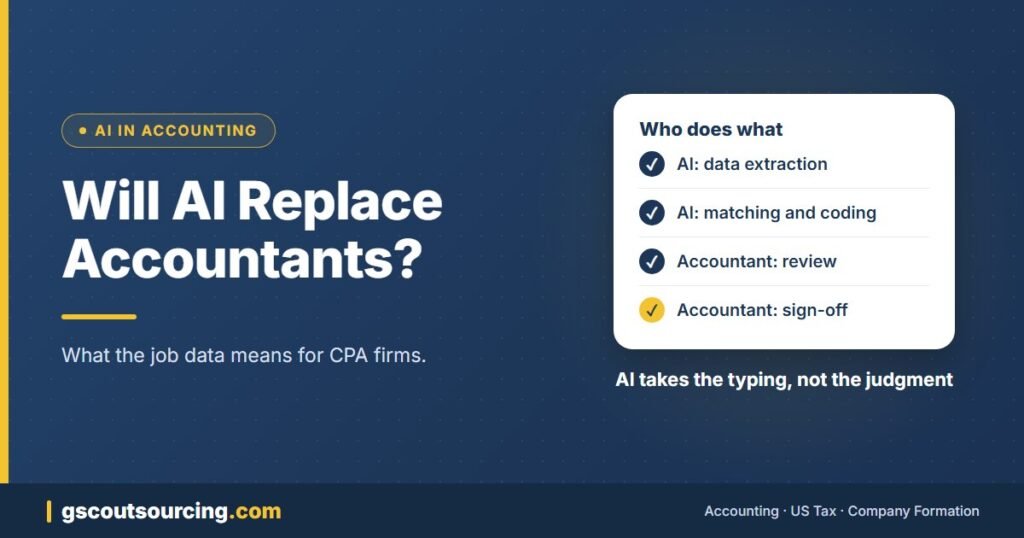
Every partner meeting seems to end on the same question. If AI can categorize transactions, draft workpapers and read source documents, will firms still need as many accountants? And should you hire for next tax season at all?
This guide looks at what the official job data says, which tasks AI already handles well, and where a CPA's judgment still decides the outcome.
No, AI is not expected to replace accountants. The US Bureau of Labor Statistics projects accountant and auditor jobs to grow 5% from 2025 to 2035, faster than average. What AI is replacing is routine data work: the BLS projects bookkeeping and accounting clerk jobs to fall 6% over the same period. For CPA firms, the shift is from keying data to reviewing it and advising on it.
Quick answers
- Are accounting jobs shrinking? Not for accountants and auditors. BLS projects 5% growth from 2025 to 2035.
- Which jobs are shrinking? Clerk roles. BLS projects a 6% decline as software automates their tasks.
- What does AI do well today? Data extraction, transaction matching, first-pass categorization and flagging exceptions.
- What still needs a person? Judgment calls, review, sign-off, client advice and professional responsibility.
- What should firms do now? Redesign workflows so people review AI output, and train staff for review and advisory work.
Will AI replace accountants? What does the job data say?
The official outlook points the other way: demand for accountants is projected to grow, while routine clerical work shrinks.
The BLS Occupational Outlook Handbook (last modified October 29, 2026) gives these figures for accountants and auditors:
| Measure | Accountants and auditors | Bookkeeping, accounting and auditing clerks |
|---|---|---|
| Jobs in 2025 | 1,595,200 | 1,532,400 |
| Projected change, 2025 to 2035 | +5% (faster than average) | -6% (decline) |
| Openings each year, on average | About 115,300 | About 144,100 |
| Median pay, May 2025 | $83,680 | $50,670 |
The BLS explains the gap directly. For accountants, it expects AI, cloud computing and blockchain to automate some routine tasks, but says this "is not expected to reduce overall demand." For bookkeeping and accounting clerks, it expects software to let the same work be done with fewer people.
Which accounting tasks can AI already do?
AI is good at repetitive, pattern-based work with clear inputs: reading documents, matching records and suggesting categories.
- Data extraction. Reading invoices, receipts, bank statements and tax forms into structured data.
- Transaction matching. Pairing bank lines with ledger entries during reconciliations.
- First-pass categorization. Suggesting the account for each transaction based on past coding.
- Exception flagging. Pointing out duplicates, unusual amounts or missing documents for a person to check.
- Drafting. Producing first drafts of client emails, memos and variance explanations.
Each of these saves time, but each produces output that can be wrong. A suggested category or a matched payment is a starting point, not a finished answer.
What can't AI do in an accounting firm?
AI can't take professional responsibility. Judgment, sign-off and the client relationship stay with licensed people.
Work that still needs an accountant
- Deciding how to treat unusual transactions under GAAP or tax law
- Reviewing and signing off on returns, financial statements and audit work
- Explaining results to clients and advising on what to do next
- Spotting when the data itself is wrong or incomplete
- Handling client data under IRC Section 7216, the FTC Safeguards Rule and your WISP
That last point matters more as AI use grows. Before client data goes into any AI tool, firms need to know where it is stored and who can see it. Our WISP guide covers the security plan.
Need review capacity, not more data entry?
Our offshore accountants work inside your systems and review every AI-assisted output.
How is the accountant's role changing?
Less time typing numbers in, more time checking them and explaining what they mean.
The BLS says that as routine tasks such as data entry are automated, accountants' "advisory and analytical duties" will become more prominent. In practice, firms see three shifts:
- Preparers become reviewers. Staff spend more time checking AI-prepared work and less time building it from scratch.
- Review skills matter earlier. Junior staff need to spot errors in output they didn't create.
- Advisory grows. Faster processing frees time for planning, forecasting and client conversations.
Our AI for CPA firms guide and the AI month-end close guide show where these tools fit in real workflows.
Should CPA firms still hire for the 2027 tax season?
Yes. AI reduces hours per return, but firms still need trained people to review, sign and advise.
The harder question is what kind of people to hire. Many firms now look for staff who can work in their tax and accounting software, review AI-assisted output and follow the firm's data-security rules. Offshore teams are one way to add that capacity, typically at 60-70% less than a comparable local hire. Our tax season staffing guide compares the options.
Planning next season's team around AI? Book a free 30-minute call and we'll talk through the mix of people and tools with you.
Frequently asked questions
What CPA firm owners ask about AI and their staff.
Will AI replace bookkeepers?
AI is reducing demand for routine bookkeeping and clerk work. The BLS projects a 6% decline in bookkeeping, accounting and auditing clerk jobs from 2025 to 2035. It also expects remaining clerks to take on more analysis and advisory work as data entry is automated.
Will AI replace CPAs?
There is no sign of that. CPAs sign returns and audit reports and carry professional responsibility, which AI can't do. The BLS projects accountant and auditor jobs to grow 5% from 2025 to 2035.
What accounting jobs are safest from AI?
Roles built on judgment, review and client advice: tax planning, advisory, audit, technical accounting and controller work. Roles built mainly on keying data are the most exposed.
Is it safe to put client data into AI tools?
Only if you know how the tool stores and uses the data, and your firm's 7216 consents, Safeguards Rule controls and WISP cover it. Some firms anonymize data before any AI tool sees it. GSC does this as standard.
How should a small firm start with AI?
Pick one repetitive task, such as bank reconciliations or document intake. Test a tool on it, keep a person reviewing every output, and measure the time saved before you expand.
The bottom line
AI isn't replacing accountants. It is replacing the typing. The BLS projects 5% growth for accountants and auditors to 2035 and a 6% decline for clerks. Firms that redesign their work so people review AI output, and that hire for review and advisory skills, will get the most from both.
Build a team that works with AI, not against it
GSC Outsourcing's offshore accountants use AI for the data entry and review every output. Client data is anonymized before any AI touches it.
Related reading: AI for CPA Firms in 2026: What Actually Works, What to Avoid and How to Start in 30 Days
