
Bank reconciliation is the job nobody wants and everybody needs. Someone has to tick every bank line against the books, chase the ones that don't match and explain the difference. In a growing business with several accounts and cards, it can take days each month.
AI tools now promise to do most of it automatically. This guide explains how AI bank reconciliation actually works, where it saves real time, and which checks a person still has to own.
AI bank reconciliation uses software that reads your bank feed, suggests a match in the ledger for each transaction, and learns from your past coding. It clears the routine matches quickly and flags the rest. A person still reviews the suggested matches, investigates exceptions and signs off that the bank balance agrees with the books.
Quick answers
- What does AI do? Reads bank lines, suggests matches and categories, and flags items it can't match.
- Does it replace the bookkeeper? No. It changes the job from matching to reviewing.
- Where does it struggle? Split payments, vague descriptions, transfers between your own accounts and one-off items.
- How often should you reconcile? At least monthly; weekly or daily is easier with AI doing the first pass.
- Is it safe? Only with clear data controls. Ask where your data goes and who can see it.
What is AI bank reconciliation?
It is the normal reconciliation process with software doing the first pass of matching and categorizing.
Reconciliation compares two records: your bank statement and your general ledger. Every deposit and payment should appear in both. Traditional software matches on exact amounts and dates. AI-assisted tools go further. They read the transaction description, compare it with how similar items were coded before, and suggest the most likely match or account even when details differ.
This is the kind of routine work official forecasts expect software to absorb. The US Bureau of Labor Statistics projects bookkeeping, accounting and auditing clerk jobs to fall 6% from 2025 to 2035, because software has automated many of their tasks. It also expects the remaining clerks to spend more time analyzing the books instead of entering data.
The goal hasn't changed. At the end, the reconciled balance in the books must agree with the bank statement, and every difference must have an explanation.
How does AI bank reconciliation work step by step?
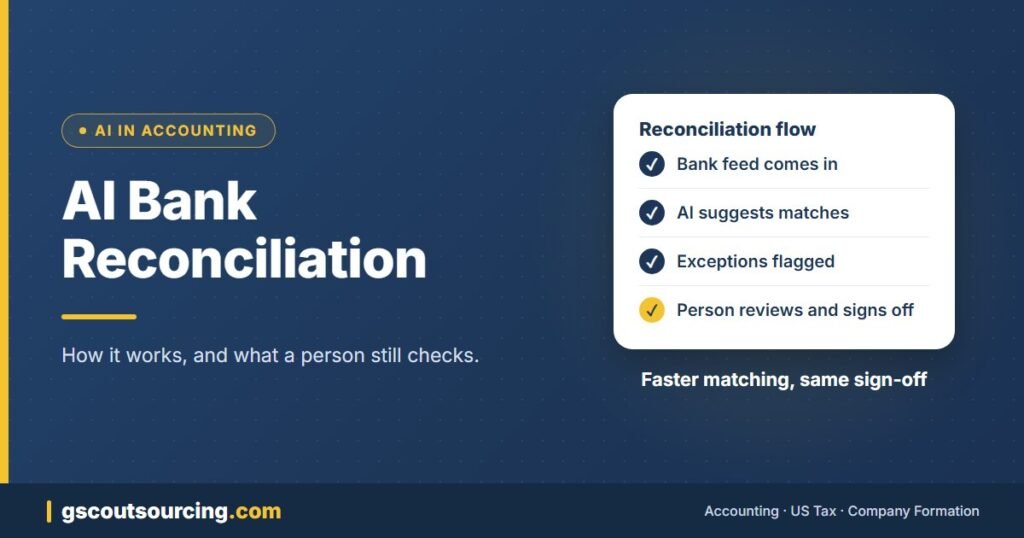
The AI prepares, a person reviews, and the books are closed only after sign-off.
- Bank data comes in. Transactions arrive through a bank feed or an uploaded statement.
- AI suggests matches. Each bank line is paired with an invoice, bill, payment or journal entry already in the ledger.
- AI suggests categories. Lines with no match get a suggested account, based on past coding.
- Exceptions are flagged. Duplicates, unusual amounts and items with no likely match go to a review list.
- A person reviews. They accept, correct or investigate each suggestion and exception.
- Sign-off. The reconciled balance is checked against the statement and the reconciliation is saved with notes.
Steps 2 to 4 are where AI saves time. Steps 5 and 6 are where errors get caught.
Want reconciliations done every month?
Our team reconciles inside your software and reviews every AI-assisted match.
What does AI get wrong in bank reconciliations?
AI learns from patterns, so it struggles with anything new, unclear or split across several records.
| Situation | What can go wrong | What the reviewer checks |
|---|---|---|
| One deposit pays several invoices | Matched to the wrong invoice or only part of it | The remittance details and open invoices |
| Transfers between your own accounts | Booked as income or expense | That both sides are recorded as a transfer |
| Vague descriptions | Wrong account suggested with high confidence | The receipt or bill behind the payment |
| Card processor payouts | Net amount matched without fees and refunds | That gross sales, fees and refunds are each recorded |
| New vendors or one-off items | No history to learn from | The right account and any missing documents |
A wrong match can make the reconciliation look finished while the books are still wrong. That is why the review step can't be skipped.
What should a person still check?
The reviewer owns the result: every accepted match, every exception and the final balance.
Your monthly review checklist
- Spot-check a sample of auto-accepted matches, not just the flagged ones
- Clear or explain every unmatched item before closing
- Confirm transfers between accounts are recorded on both sides
- Check that processor payouts show sales, fees and refunds separately
- Agree the reconciled balance to the bank statement
- Save notes on anything unusual for the next month and for your accountant
Clean reconciliations feed everything else, from the month-end close to your 13-week cash flow forecast.
How do you keep your data safe with AI tools?
Know where your bank data goes, who can see it and whether it is used to train anyone else's model.
- Read the data terms. Check whether the vendor stores, shares or trains on your data.
- Limit access. Give the tool read-only bank access where possible.
- Ask your provider. If an outside team reconciles for you, ask how they protect your data. GSC anonymizes client data before any AI touches it, and works under ISO 27001 and GDPR.
Our technology page shows where AI fits in our work. Our security page and the guide on questions to ask your provider go further. Not sure whether your reconciliations are set up well? Book a free 30-minute call and we'll look at your process with you.
Frequently asked questions
What business owners ask about AI and bank reconciliations.
Can AI fully automate bank reconciliation?
AI can handle most routine matches, but not all of them. Split payments, transfers and new items still need a person. Someone also has to sign off that the books agree with the bank statement.
How accurate is AI bank reconciliation?
It depends on your data and past coding. Clean, consistent history gives better suggestions. Treat every suggestion as a draft until a person has reviewed it, and spot-check auto-accepted matches.
Does my accounting software already use AI for reconciliation?
Many accounting platforms now suggest matches and categories from your bank feed. Check your software's help pages to see what it does and how to review its suggestions.
How often should a small business reconcile?
At least once a month, before you close the books. With AI doing the first pass, many businesses reconcile weekly, which makes problems easier to spot and fix.
Should I outsource bank reconciliation?
If reconciliations keep slipping or the month-end close drags, outsourcing can help. Look for a team that works in your software, reviews every AI-assisted match and explains how it protects your data.
The bottom line
AI bank reconciliation takes the slow matching work off your plate, but it doesn't take away the responsibility. Let the software prepare the matches and flag exceptions, then have a person review, explain and sign off every month. That mix gives you faster closes and books you can trust.
Reconciled books every month, reviewed by a person
GSC Outsourcing uses AI for the data entry and an accountant reviews every output. Client data is anonymized before any AI touches it.
Related reading: How AI Is Changing Month-End Close (Without Replacing Accountants)
