
Your profit and loss statement says the business made money last quarter. Your bank balance says payroll is going to be tight next Friday. Both can be true at once, and the gap between them is where most cash surprises come from.
A 13-week cash flow forecast closes that gap. This guide walks through what goes into one, how to build it in a spreadsheet, and how to keep it accurate week after week.
A 13-week cash flow forecast is a week-by-week view of the cash you expect to come in and go out over the next quarter. You build it from your bank balance, expected customer receipts and scheduled payments, then update it every week with actuals. It shows a cash shortfall weeks before it happens, while you still have time to act.
Quick answers
- What is it? A weekly plan of cash in and cash out for the next 13 weeks.
- Why 13 weeks? It covers a full quarter in enough detail to see each payroll and rent week.
- What do you need to start? Bank balances, open invoices, open bills, the payroll calendar and loan schedules.
- How often should you update it? Every week, comparing last week's forecast with what actually happened.
- Is it the same as a budget? No. A budget plans profit for the year. This forecast tracks cash timing week by week.
What is a 13-week cash flow forecast?
It is a rolling, week-by-week projection of cash receipts, cash payments and the ending cash balance for the next 13 weeks.
Each column is one week. Each row is a source or use of cash. The forecast starts with the cash you have today, adds what you expect to collect, subtracts what you expect to pay, and shows the balance at the end of every week.
It is called rolling because every week you drop the week that just ended and add a new week at the end. You always look 13 weeks ahead.
The key difference from your financial statements is timing. Your income statement records revenue when you earn it. The forecast records cash only when it actually lands in or leaves your bank account. Our guide to cash vs. accrual accounting explains the difference.
Why does a 13-week cash flow forecast matter for a growing business?
Growing businesses often run short of cash even when sales are strong, because they pay staff and suppliers before customers pay them.
A weekly forecast helps you:
- See shortfalls early. A tight week shows up weeks in advance, not the day before payroll.
- Time big payments. Schedule equipment purchases, bonuses or tax payments for weeks with room to spare.
- Talk to your lender with numbers. If you need to draw on a line of credit, you can show when and for how long.
- Chase the right customers. The forecast shows which overdue invoices matter most to next month's balance.
- Make hiring decisions. Test whether the business can carry a new salary before you make the offer.
What goes into a 13-week cash flow forecast?
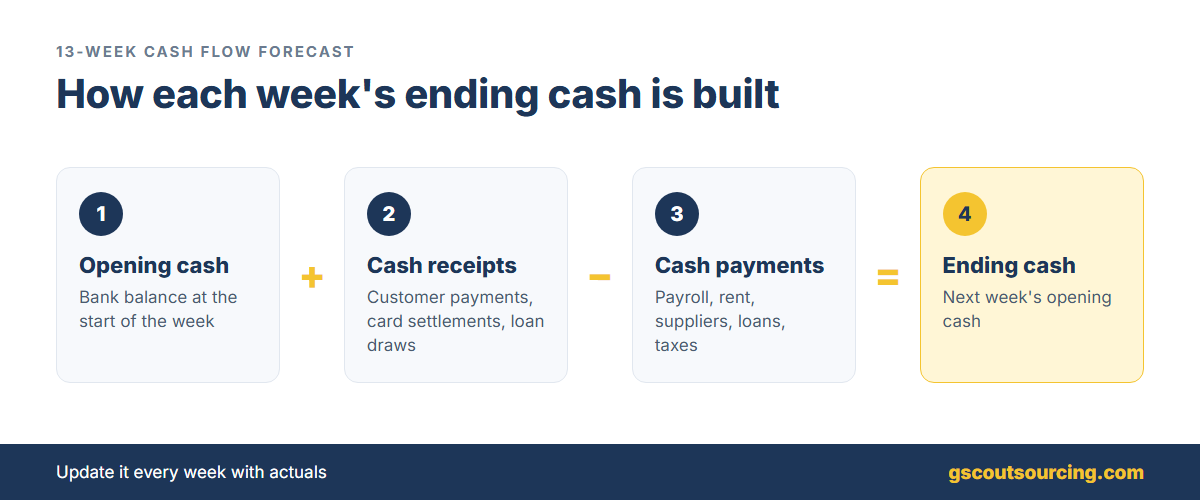
Three blocks: opening cash, cash receipts and cash payments. Together they give you the ending cash balance for each week.
| Section | Typical lines | Where the numbers come from |
|---|---|---|
| Opening cash | Balance in each operating bank account | Bank statements on the start date |
| Cash receipts | Customer collections, card settlements, loan draws, other income | Accounts receivable aging, payment terms, sales pipeline |
| Operating payments | Payroll and payroll taxes, rent, suppliers, software, insurance, utilities | Payroll calendar, accounts payable aging, contracts |
| Other payments | Loan repayments, estimated taxes, equipment, owner draws | Loan schedules, tax calendar, planned purchases |
| Ending cash | Opening cash plus receipts minus payments | Calculated |
Many businesses also add a line for the minimum cash balance they want to keep. Any week that falls below it is flagged for action.
Rather have the forecast built and kept up to date for you? Book a free 30-minute call.
How do you build a 13-week cash flow forecast step by step?
Start with what you know for certain, then add estimates, then check the result against your recent bank history.
- Set up the sheet. Put 13 week columns across the top, each starting on the same weekday. List your receipt and payment lines down the side.
- Enter opening cash. Use the actual bank balance on the first day of week one. Include only accounts the business can spend from.
- Forecast collections. Place each open customer invoice in the week you realistically expect payment, based on how that customer has paid before, not just the due date. Then add expected new sales and when they will turn into cash.
- Add fixed payments. Enter payroll on each pay date, plus rent, loan payments, insurance and subscriptions.
- Add supplier payments. Use your open bills and normal purchasing pattern, placed in the week you plan to pay.
- Add one-off items. Estimated tax payments, annual renewals, equipment and owner distributions.
- Check the totals. Compare forecast receipts and payments with the last few months of bank activity. If the forecast looks much better than your history, find out why before you rely on it.
Write a one-line note next to every large number explaining where it came from. Anyone reviewing the forecast can then challenge the assumption, not just the figure.
How do you keep the forecast accurate week after week?
Update it on the same day every week, compare last week's forecast to actual cash, and adjust the assumptions that missed.
Your weekly update routine
- Replace last week's forecast with what actually came in and went out
- Explain the big differences: a late customer, an early bill, a sale that slipped
- Fix the assumption, not just the number (if a customer always pays two weeks late, move all of their receipts)
- Drop the finished week and add week 13
- Flag any week that falls below your minimum cash balance
The forecast is only as good as your books. If bank accounts aren't reconciled and bills aren't entered on time, the opening balance and payables lines will be wrong. A steady month-end close keeps the inputs clean.
Forecasts start with clean books
Our Client Accounting Services team keeps reconciliations, payables and receivables current inside your own accounting software.
What mistakes make a cash flow forecast unreliable?
Most problems come from optimistic collection timing and from payments people forget to include.
- Using due dates instead of real payment habits. Customers on 30-day terms often pay later. Use their history.
- Mixing profit and cash. Depreciation and other non-cash expenses don't belong in a cash forecast. Loan principal payments and equipment purchases do.
- Forgetting irregular payments. Annual insurance, estimated taxes and software renewals are easy to miss.
- Building it once and leaving it. A forecast that isn't updated weekly stops being useful within a month.
Frequently asked questions
Straight answers to what business owners ask about cash forecasting.
What is the difference between a 13-week cash flow forecast and a budget?
A budget sets revenue and expense targets for the year, usually by month, and focuses on profit. A 13-week cash flow forecast tracks when cash actually moves in and out, week by week. Many businesses use both: the budget for annual planning and the cash forecast for day-to-day decisions.
Can I build a 13-week cash flow forecast in Excel?
Yes. Most small businesses use a spreadsheet in Excel or Google Sheets. You need 13 weekly columns, a list of receipt and payment lines, and a formula for ending cash. Dedicated forecasting software can help as volume grows.
Who should own the cash flow forecast?
One person should update it every week, usually the controller, finance manager or an outside finance team. The owner or CEO should review it every week too, because the decisions it drives, such as hiring, spending and borrowing, sit with leadership.
How accurate should a 13-week forecast be?
The first few weeks should be close to actual results, because most of those receipts and payments are already known. Later weeks will be less precise. Track the difference between forecast and actual each week, and if the gap keeps growing, review your assumptions.
When should a business start using a 13-week cash flow forecast?
Start when cash is tight, when the business is growing quickly, before taking on a loan, or when payroll and supplier payments are large compared to the bank balance. Many businesses keep one running all the time because it costs little to maintain once it is set up.
The bottom line
A 13-week cash flow forecast doesn't need special software or a finance degree. It needs accurate opening numbers, honest assumptions about when customers pay, and a weekly habit of comparing forecast with actual. Get those three right and cash surprises turn into decisions you make weeks in advance.
Plan your cash weeks ahead, not days ahead
GSC Outsourcing's CFO & Financial Planning team builds your rolling forecast and cash-flow view, so leadership plans on numbers it trusts.
Related reading: Year-End Close Checklist 2026: What US Small Businesses Should Do Before December 31
