

December is short. Between holidays, final invoices and payroll, the year-end close often slips into January, when W-2s and 1099s are already due. That is when mistakes get in.
The short answer: a year-end close checklist splits the work into two parts. Before December 31, make the choices that only count if they happen in 2026, such as buying equipment, funding retirement plans and collecting W-9s. After December 31, reconcile every account, review receivables, payables and inventory, then lock the books so your tax preparer gets clean numbers.
This checklist covers both parts, plus the January 2027 dates that depend on a clean close.
| Quick answers What is a year-end close? Finishing, checking and locking your books for the full year. When should you start? In early December, with tax-timing decisions made before December 31. What is the 2026 1099-NEC threshold? $2,000 for payments made in 2026, up from $600. When are W-2s and 1099-NECs due? February 1, 2027, because January 31 falls on a Sunday. When is the last 2026 estimated tax payment due? January 15, 2027. |
What is a year-end close?
A year-end close is the process of finishing, checking and locking your accounting records for the full year, so your financial statements and tax return start from accurate numbers.
It is a bigger version of the month-end close. Each month you reconcile and review. At year end you also count inventory, review fixed assets, true up payroll and prepare the forms your workers and the IRS expect in January. If you use the cash method, timing matters even more, because income and expenses generally count in the year the cash moves. Our guide to cash vs accrual accounting explains the difference.
What should a small business do before December 31?
Focus first on the actions that only count for 2026 if they happen in 2026. Once the year ends, these choices are gone.
| Action | Why it matters before December 31 | Ask your CPA |
| Put new equipment into service | Under IRS Notice 2026-11, 100% bonus depreciation is now permanent for qualifying property acquired after January 19, 2025. The asset must be placed in service in the year you claim it. | Expense it all now, or spread it over several years? |
| Use the de minimis safe harbor | The IRS tangible property rules let most small businesses expense items costing up to $2,500 per invoice or item, if a consistent policy was in place at the start of the year. | Is our policy written down and applied the same way? |
| Fund retirement plans | Employee 401(k) deferrals generally come out of 2026 pay. The 2026 limit is $24,500, plus catch-up amounts for workers 50 and older. | What are our plan deadlines for employer contributions? |
| Time income and expenses | On the cash method, paying deductible bills in December or invoicing in January can move income between years. | Does 2027 income make this worth doing? |
| Collect W-9s from contractors | You need each contractor's legal name and taxpayer ID before you can file 1099s. | Which contractors crossed $2,000? |
| Check payroll details | Names, addresses and Social Security numbers must be right for W-2s, and December bonuses must run through payroll. | Are year-end bonuses set up correctly? |
Also bring your mileage log up to date. 2026 has two business rates: 72.5 cents per mile for miles driven from January 1 to June 30, and 76 cents per mile from July 1, after a midyear IRS increase. Planning ahead for next year? Our post on 2027 tax brackets for small business owners covers what changes.
What steps belong on a year-end close checklist?
Close the books in a fixed order: reconcile cash first, then work through receivables, payables, inventory, assets, payroll and loans, and finish by reviewing the reports and locking the period.
1. Reconcile every bank and credit card account to the December 31 statements. Clear old uncleared checks and duplicate transactions.
2. Review accounts receivable. Chase overdue invoices. If you use accrual accounting, write off invoices you will not collect.
3. Record unpaid bills and accrued expenses. On the accrual method, record December costs even if the bill arrives in January.
4. Count inventory on or near December 31 and adjust the books to match the count.
5. Update fixed assets. Add 2026 purchases, remove items you sold or scrapped, and post depreciation.
6. Reconcile payroll. Wages and payroll taxes in your books should match your payroll reports and your four quarterly Forms 941.
7. Reconcile loans and credit lines to lender statements, splitting interest from principal.
8. Review owner accounts. Record owner draws, contributions and any personal costs paid by the business.
9. Review the profit and loss statement and balance sheet. Compare them with 2025 and look into anything that changed sharply.
10. Lock the period in your accounting software and send the final reports to your tax preparer.
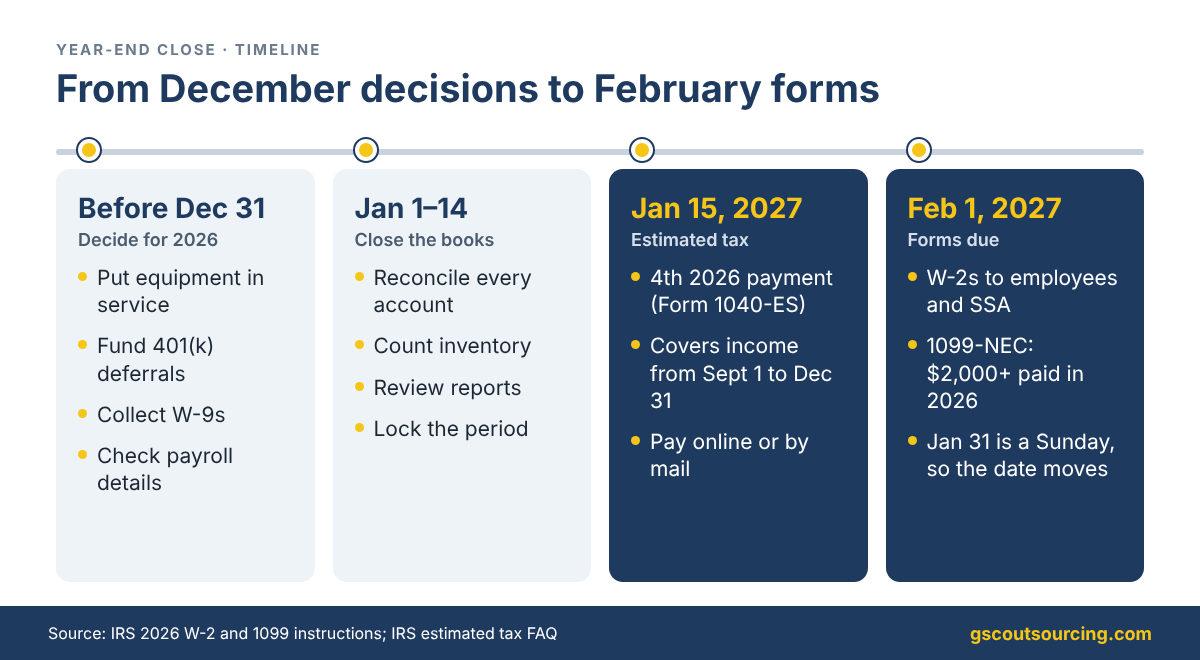
You can run steps 1 to 3 for November in early December, which leaves far less for January.
Which tax forms are due in January 2027?
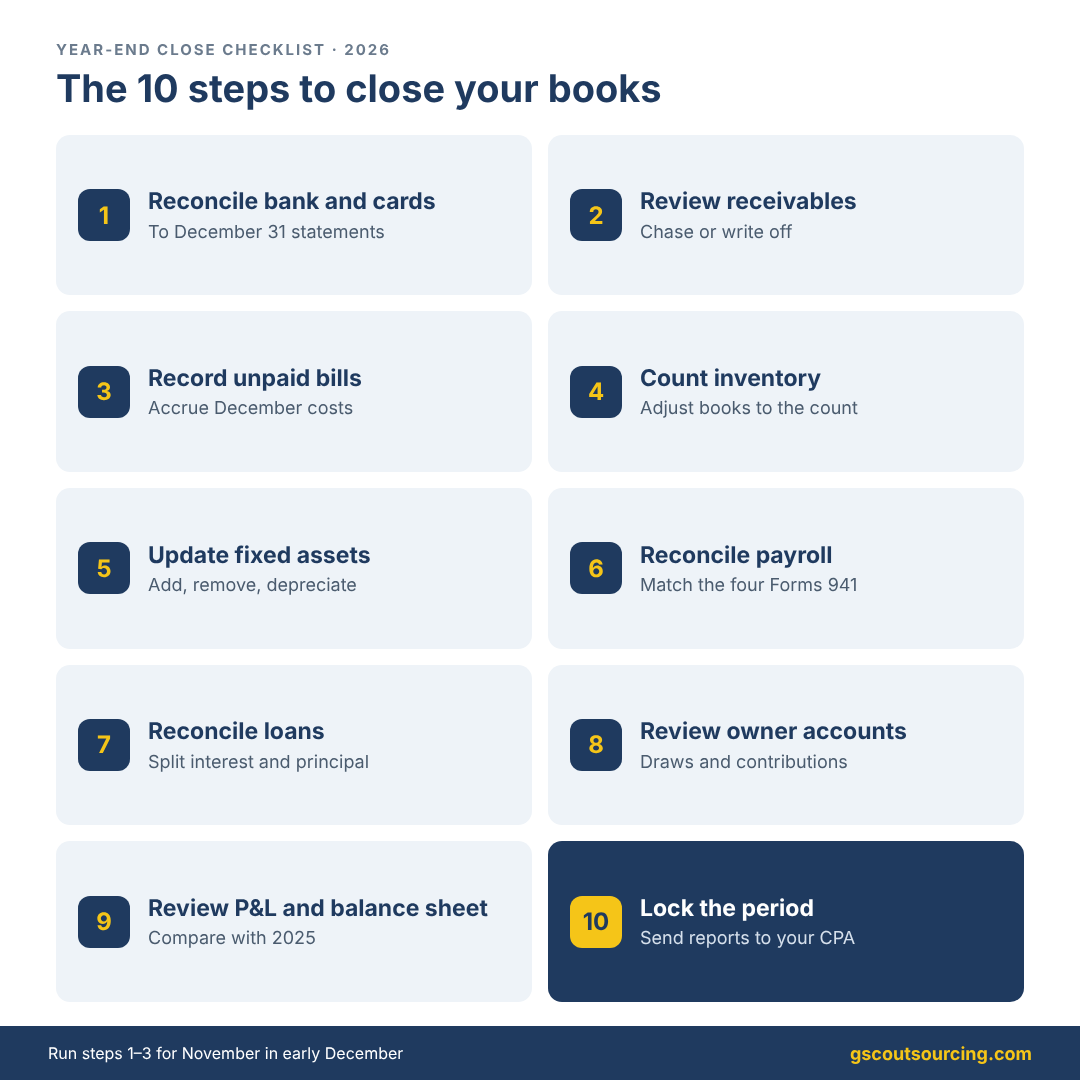
The main dates are January 15, 2027 for the last 2026 estimated tax payment and February 1, 2027 for W-2s and Forms 1099-NEC, because January 31 falls on a Sunday.
| Form | What it reports | 2026 rule | Due |
| Form 1099-NEC | Payments to non-employees for services | File for each person paid $2,000 or more in 2026 (was $600) | February 1, 2027, to workers and the IRS |
| Form 1099-MISC (rents) | Rent paid for offices or equipment | Rents of $2,000 or more | Recipient copy by February 1, 2027 |
| Form W-2 | Employee wages and tax withheld | Every employee paid wages in 2026 | February 1, 2027, to employees and the SSA |
| Form 1040-ES, 4th payment | Estimated tax on 2026 income | Owners who pay estimated tax | January 15, 2027 |
The IRS instructions for Forms 1099-MISC and 1099-NEC confirm the new $2,000 threshold, and the 2026 Form W-2 instructions set the February 1 date. The higher threshold means fewer forms for many businesses, but only if your records show exactly what you paid each contractor. Pull a vendor payment report before you decide who gets a form.
| Books a few months behind? There is still time before December 31. Book a free 30-minute call → |
What are the most common year-end close mistakes?
Most year-end problems come from rushing: skipped reconciliations, missing contractor details and personal spending mixed into business accounts.
• Reconciling only the main bank account. Credit cards, loans and payroll accounts drift too.
• Waiting until January for W-9s. Contractors are harder to reach once they have been paid.
• Expensing large purchases without a policy. The de minimis safe harbor needs a consistent policy from the start of the year.
• Leaving the period open. Edits made after your CPA starts the return create mismatches.
• Using one mileage rate for the whole year. 2026 has two business rates, split at July 1.
Should you do the year-end close yourself?
If your books were reconciled every month, you can usually close the year yourself with this checklist. If several months are behind, get help in November or December, not in March.
A clean year-end close mostly reflects the eleven months before it. Catching up a full year of bank feeds in January is slow and easy to get wrong. If that sounds familiar, read our guide to the signs it's time to outsource your bookkeeping.
Frequently asked questions
What is included in a year-end close checklist?
A year-end close checklist usually covers reconciling bank, card and loan accounts, reviewing receivables and payables, counting inventory, updating fixed assets and depreciation, reconciling payroll, reviewing owner accounts and financial statements, and locking the period. It should also list the tax forms due in January, such as W-2s and 1099s.
When should I start my year-end close?
Start in early December. Make tax-timing decisions, such as equipment purchases and retirement contributions, before December 31, and reconcile November while things are quiet. Then finish the December reconciliations, inventory count and reviews in the first two weeks of January, ahead of the February 1 deadline for W-2s and Forms 1099-NEC.
What is the 1099-NEC threshold for 2026?
For payments made in 2026, you file Form 1099-NEC for each non-employee you paid $2,000 or more for services. The threshold was $600 for payments made before 2026. Forms for 2026 payments are due to workers and the IRS by February 1, 2027, because January 31 falls on a Sunday.
Can I deduct equipment bought in December?
Generally yes, if the equipment is placed in service by December 31, not just ordered or paid for. Qualifying property acquired after January 19, 2025 can get 100% bonus depreciation, which is now permanent. Your CPA can tell you whether to deduct it all in 2026 or spread it over several years.
What is the IRS business mileage rate for 2026?
The IRS business standard mileage rate is 72.5 cents per mile for miles driven from January 1 to June 30, 2026, and 76 cents per mile from July 1, 2026. Keep your mileage log split at July 1 so each trip gets the right rate.
Do I need a year-end close if I use cash accounting?
Yes. Cash-basis businesses still need to reconcile every account, confirm income and expenses are in the right year, update fixed assets and reconcile payroll. The close is simpler than an accrual close because there are fewer accruals, but your tax return still depends on accurate year-end numbers.
| Start 2027 with books you can trust A year-end close is easier when someone owns it. Since 2020, GSC Outsourcing has helped businesses in 32+ countries keep their books accurate and on time. Book a free 30-minute call → |
Related reading:A practical checklist for your first month-end close · In-House Bookkeeper vs Outsourced Bookkeeping vs Software Only: Which Fits a Small US Business?
