
Most small business owners start with bookkeeping software and a spare evening. Then sales grow, bank feeds pile up, and a new question comes up: in-house vs outsourced bookkeeping, or keep going with software alone?
The short answer: software only fits very simple businesses whose owner reviews the books every month. An in-house bookkeeper fits when you need someone on site every day and have enough work for the role. Outsourced bookkeeping fits most growing small businesses that need accurate monthly books, a reviewer and cover when people are away, without managing a hire.
This guide compares all three side by side and gives you a simple way to decide.
| Quick answers Is bookkeeping software enough on its own? For simple businesses, if someone reviews it every month. When should you hire an in-house bookkeeper? When there is full-time, on-site work every day. What does outsourced bookkeeping include? Reconciliations, payables, receivables, month-end close and reports. Which costs less? It depends on volume. Salary is only part of what a hire costs. Can you mix options? Yes. Many businesses keep their software and outsource the monthly work. |
What are your three bookkeeping options?
Bookkeeping is the work of recording and checking every transaction so your financial reports are accurate. You can do it with software alone, with an in-house bookkeeper on your payroll, or with an outsourced team that works in your systems.
• Software only: you or a staff member use a tool such as QuickBooks or Xero to categorize bank feeds and send invoices.
• In-house bookkeeper: an employee, full-time or part-time, who keeps the books in your office or remotely.
• Outsourced bookkeeping: an outside team does the work in your software each month, usually with a reviewer.
In-house vs outsourced bookkeeping vs software: how do they compare?
The biggest differences are who checks the work, what happens when someone is away, and how cost grows as you grow.
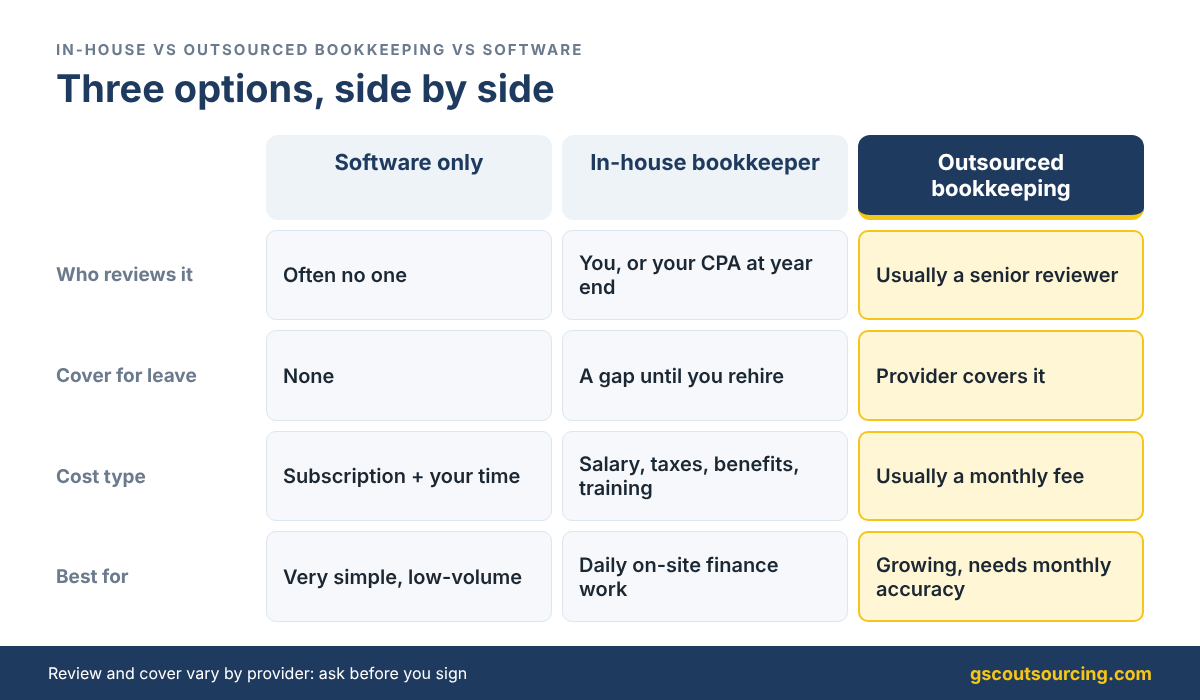
| Factor | Software only | In-house bookkeeper | Outsourced bookkeeping |
| Who does the work | You or a staff member | Your employee | An outside team, in your software |
| Who reviews it | Often no one | You, or your CPA at year end | Usually a senior reviewer (ask each provider) |
| Cost type | Subscription plus your time | Salary, payroll taxes, benefits and training | Usually a monthly fee |
| Cover for leave or turnover | None | A gap until you rehire | The provider covers it |
| Skills | Depends on you | One person's skills | A team's skills |
| Daily on-site tasks | No | Yes | Limited |
| Best for | Very simple, low-volume businesses | Daily on-site finance work | Growing businesses that need monthly accuracy |
When is bookkeeping software enough on its own?
Software alone works when transactions are few and simple and the owner reviews the books every month.
Today's tools pull in bank feeds, suggest categories and send invoices. What they can't do is notice that a category is wrong every month, or that a loan payment was booked entirely as an expense. Software only is usually enough if most of these are true:
• You have one or two bank accounts and a few dozen transactions a month.
• You don't hold inventory or run payroll for many people.
• You use cash accounting and don't need monthly reports for a lender or investor.
• You reconcile every month, not once a year.
If you catch up several months at a time, software only is costing you more than it looks.
When does an in-house bookkeeper make sense?
Hire in-house when you have a full-time, daily workload that needs someone on site, such as handling cash, receiving goods or working closely with operations.
A hire costs more than the salary. In June 2026, benefits made up 30% of private employers' total compensation costs, according to the Bureau of Labor Statistics. Add recruiting, training, software seats and the time you spend managing the role.
There is also a control issue. With one bookkeeper, the same person often records payments, reconciles the bank and sets up vendors. Small businesses can't always split those duties, so someone else should review the work each month. And when that person is sick, on leave or quits, the books stop.
The role is changing too. The BLS projects employment of bookkeeping, accounting and auditing clerks to decline 6% from 2025 to 2035.
When is outsourced bookkeeping the better fit?
Outsourcing fits when you need accurate monthly books, a second set of eyes and steady cover, but not a full-time person in your office.
A good outsourced team works in your existing software, follows a monthly close calendar and has a reviewer check the work before it reaches you. You get a team instead of one person, so holidays and turnover don't stop the books.
Want one dedicated person rather than a team? Our comparison of outsourcing vs offshore staffing explains both models. Not sure it's time to change? Read the signs it's time to outsource your bookkeeping.
| Want a dedicated bookkeeper without a local hire? With our offshore staffing model, a dedicated finance specialist works in your systems and follows your process. See offshore staffing → |
How do you choose the right bookkeeping option?
Answer five questions in order. The first one that points clearly to an option usually decides it.
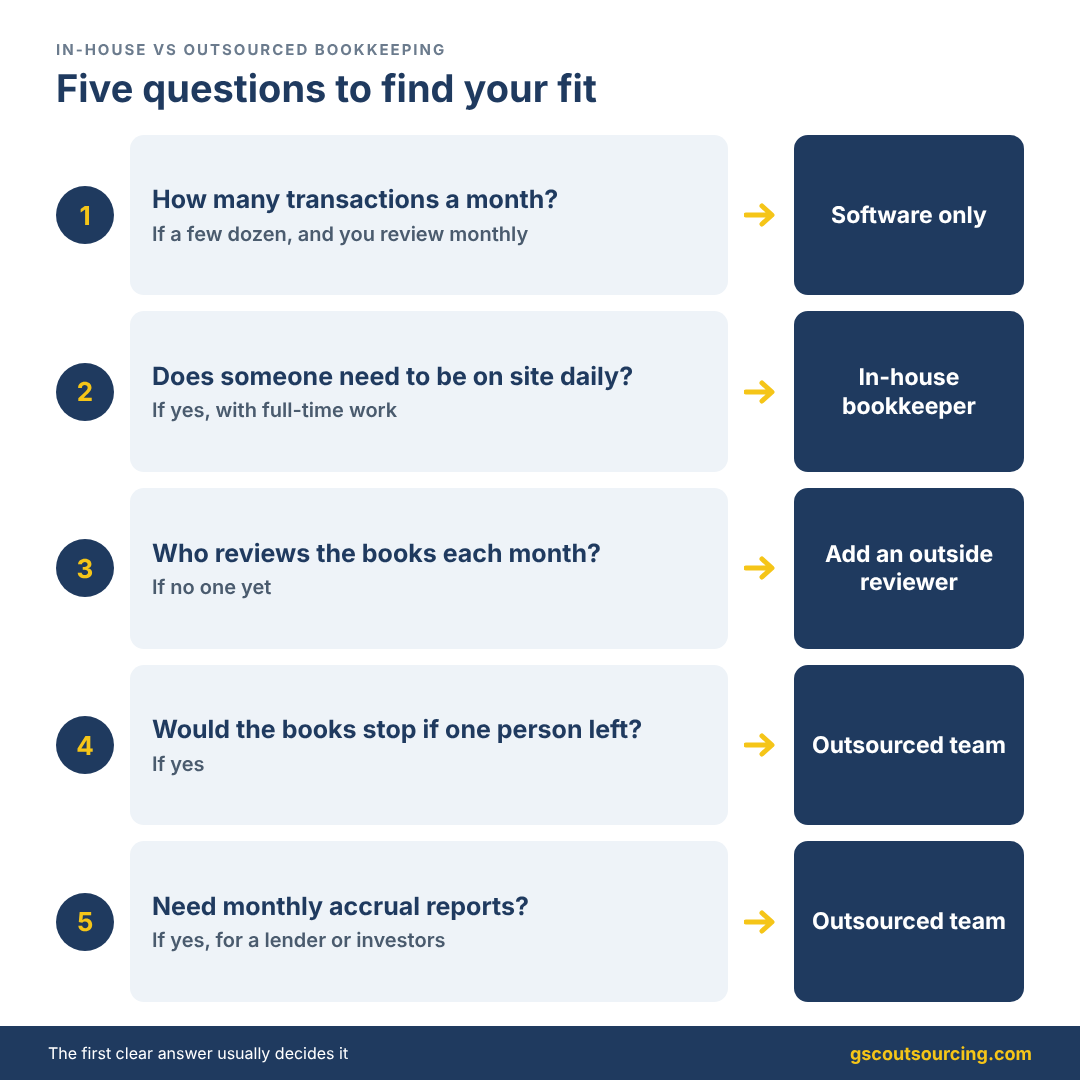
1. How many transactions do you have each month? A few dozen leans toward software only. Hundreds lean away from it.
2. Does someone need to be on site every day? If yes, in-house is likely.
3. Who will review the books each month? If the answer is no one, software only is risky.
4. What happens if your bookkeeper leaves? If the books would stop, add cover from an outside team.
5. What do your lender, investors or CPA need? Monthly accrual reports usually need more than software alone.
Can you combine in-house, outsourced and software?
Yes. The most common mix is your own software plus an outsourced team doing the monthly work.
Other mixes work too. An office manager can handle daily receipts and invoices while an outside team reconciles accounts and closes the month. A growing company can keep its in-house bookkeeper and outsource the review and reporting. You don't have to pick one option forever.
Frequently asked questions
Is outsourced bookkeeping cheaper than an in-house bookkeeper?
It often is for small businesses, because you pay for the work done rather than a full-time salary, payroll taxes and benefits. Benefits alone made up 30% of private employers' compensation costs in June 2026, according to the BLS. Compare the full cost of each option against your monthly transaction volume.
Can I do my own bookkeeping with software?
Yes, if your business is simple and you reconcile every account each month. Software handles bank feeds, categories and invoices well, but it can't judge whether entries are right. Without a monthly review, errors build up and surface at tax time, when they are slower and costlier to fix.
What does an outsourced bookkeeper do?
An outsourced bookkeeper records transactions, reconciles bank and card accounts, manages payables and receivables, closes the month and prepares financial reports. The team usually works inside your own accounting software, such as QuickBooks or Xero, and a reviewer checks the work before reports reach you.
When should a small business hire an in-house bookkeeper?
Hire in-house when there is enough work to fill the role and it needs someone on site every day, such as handling cash, receiving inventory or supporting operations. Plan for salary, payroll taxes, benefits, training and cover for leave, and make sure someone reviews the books each month.
Is outsourced bookkeeping safe?
It can be, if the provider uses strong controls. Ask about security certifications such as ISO 27001, role-based access, multi-factor login, background checks, and how your data is returned and deleted when you leave. You should be able to see exactly who has access to your accounts.
Can I switch from in-house to outsourced bookkeeping?
Yes. Most providers start with a handover of software access, your chart of accounts and open items, then run a first month-end close with you. The switch goes more smoothly if your bank accounts are reconciled to a recent month before the handover starts.
| Get monthly books you don't have to chase Whichever option you choose, the goal is the same: books that are accurate every month, not just at tax time. GSC Outsourcing's Client Accounting Services cover bookkeeping, account reconciliations, month-end close, payables, receivables, financial reporting and cleanup. Book a free 30-minute call → |
Related reading: Cash vs. accrual accounting: which basis fits your growing business? · 13-Week Cash Flow Forecast: How to Build One for a Small Business
