
Bills arrive by email, by mail and through vendor portals. Someone has to check them, get them approved and pay them on time. When that work lives in one person's inbox, things slip: late fees, double payments and vendors chasing you.
A clear accounts payable process fixes most of that. This guide walks through the steps, the controls that matter, and how to make the work faster as you grow.
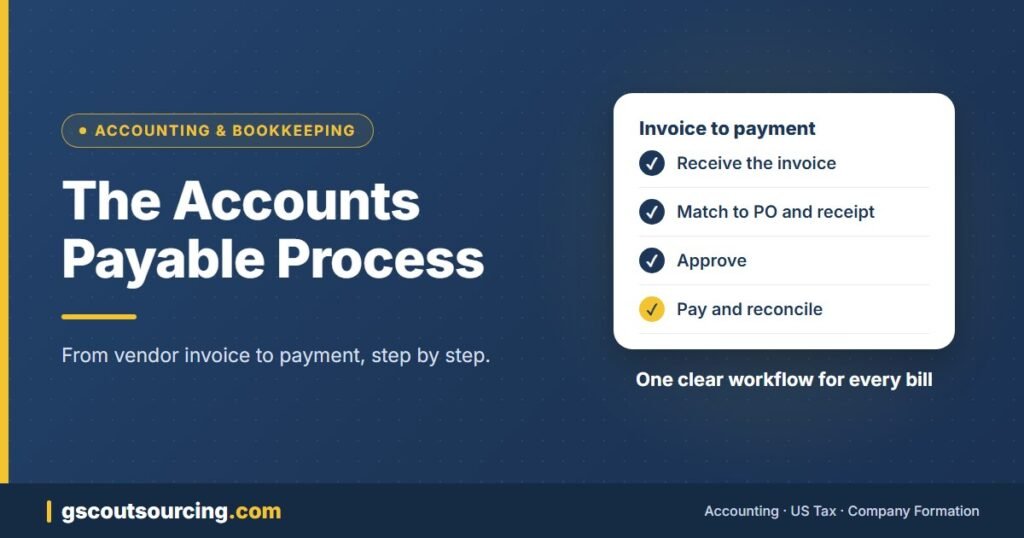
The accounts payable process is how a business takes in vendor bills, checks them, gets them approved, pays them and records them. The core steps are: set up the vendor, receive the invoice, match it to what you ordered and received, approve it, schedule payment, pay, and reconcile. Good controls split these duties so no single person can add a vendor and pay it.
Quick answers
- What is accounts payable? Money your business owes vendors for goods or services already received.
- How many steps are there? Usually seven, from vendor setup to reconciliation.
- What is three-way matching? Checking the invoice against the purchase order and the receipt.
- Who should approve bills? The budget owner, within set limits.
- Can it be automated? Yes. Capture, matching and approvals all can be.
What is the accounts payable process?
It is the routine that turns a vendor bill into a correct, approved, on-time payment and a clean entry in your books.
Accounts payable sits on your balance sheet as a liability. Each bill you record adds to it, and each payment reduces it. A good process keeps that balance accurate, so your cash forecast and month-end numbers can be trusted.
For a small business, one person may do every step. That works for a while. As bill volume grows, the risk of errors and fraud grows too, and a defined process becomes essential.
What are the accounts payable process steps?
Seven steps cover almost every business, whatever software you use.
- Set up the vendor. Collect the legal name, address, bank details and tax form. For US vendors that is a Form W-9.
- Receive the invoice. Send every bill to one inbox or portal, never to personal email.
- Check and match. Compare the invoice with the purchase order and proof of delivery.
- Code it. Assign the expense account, class or department.
- Approve it. The budget owner signs off, within limits you set.
- Schedule and pay. Pay by the due date, and take early-payment discounts that make sense.
- Record and reconcile. Post the payment and reconcile the AP ledger to the general ledger each month.
Vendor setup matters more than most owners think. The W-9 you collect at setup feeds the 1099s you file in January. Our guide to 1099 filing requirements for 2026 explains the new thresholds and deadlines.
What controls belong in an accounts payable process?
The most important control is splitting duties: the person who adds or changes vendors should not be the person who pays them.
| Risk | What can go wrong | Control that stops it |
|---|---|---|
| Fake vendor | Someone adds a vendor and pays it | Separate vendor setup from payment |
| Bank detail change | A fake email asks you to change vendor bank details | Call the vendor on a known number to confirm |
| Duplicate payment | The same invoice gets paid twice | Duplicate checks on vendor, number and amount |
| Price errors | You pay more than you agreed | Three-way match against the purchase order |
| Late fees | Bills sit unapproved past their due date | Weekly aging review and approval reminders |
Never change a vendor's bank details based on an email alone. Confirm by phone, using a number you already had on file. This one habit blocks one of the most common payment scams.
Want an outside check on your AP controls? Book a free 30-minute call and we'll go through your current process with you.
How does three-way matching work?
You check that three documents agree before you pay: the purchase order, the receiving record and the invoice.
- Purchase order: what you agreed to buy, and at what price.
- Receiving record: what actually arrived, and when.
- Invoice: what the vendor is asking you to pay.
If all three match, the bill moves to approval. If not, it goes back for a question first. Service businesses without purchase orders often use a two-way match instead: the invoice against a contract or approved quote.
Want AP off your plate?
Our team runs invoice intake, matching, approvals and reconciliations inside your own systems.
How do you automate the accounts payable process?
Start with the slow manual steps: getting invoice data in, matching and chasing approvals.
Where automation pays off first
- Invoice capture from a dedicated email address
- Reading invoice data automatically, with a person checking it
- Approval routing by amount and department
- Duplicate invoice alerts
- Scheduled payment runs, once or twice a week
- Automatic sync to your accounting system
Keep a person in the loop. Software reads invoices quickly, but someone should still review new vendors, unusual amounts and anything that fails a match. Our post on how AI is changing month-end close shows the same review model applied to the close.
How long should you keep AP records?
The IRS general rule is 3 years, but some records need to stay longer.
The IRS page on how long to keep records (updated June 30, 2026) sets 3 years as the general rule. It is 6 years if you underreport income by more than 25%, and 7 years for a bad debt or worthless securities claim. Keep employment tax records at least 4 years. Many businesses simply keep invoices and payment records for 7 years to be safe.
Frequently asked questions
Quick answers on running accounts payable well.
What is the difference between accounts payable and accounts receivable?
Accounts payable is money you owe to vendors. Accounts receivable is money customers owe you. Both sit on the balance sheet, but payable is a liability and receivable is an asset.
How often should a small business pay bills?
Many businesses run one or two payment batches a week. A fixed schedule makes cash easier to plan and cuts down on rushed, one-off payments. Pay early only when a discount makes it worth it.
Who should approve invoices?
The person who owns the budget for that spend should approve it. Set amount limits, so larger bills need a second approver. The person who approves should not be the person who adds vendors.
What is an AP aging report?
It lists unpaid bills grouped by how long they have been open, such as 0-30, 31-60 and 61-90 days. Review it weekly to spot late bills, disputes and cash needs before they become problems.
Should a small business outsource accounts payable?
It often makes sense once bills take hours each week or controls are thin because one person does everything. An outside team can run intake, matching and reconciliations while you keep final approval of payments.
The bottom line
A good accounts payable process is simple: one inbox for bills, a match before approval, approval by the budget owner, scheduled payments and a monthly reconciliation. Split vendor setup from payment, confirm bank changes by phone, and automate the slow manual steps as volume grows.
Get your AP running smoothly
GSC Outsourcing runs accounts payable and month-end work for growing US businesses. A person reviews every output.
Related reading: 5 Signs It's Time to Outsource Your Bookkeeping
