

Many founders abroad hear the same line from US investors: "We can invest once you have a Delaware C Corp." Here is why, and what it takes.
Short answer: a Delaware C Corp for foreign founders is the default because US investors know Delaware law, their deal documents are written for it, and only a corporation can issue the preferred stock and stock options a venture round needs. You do not need to live in the US or hold a US visa to own one.
Below: the reasons, the "flip" for companies that already exist abroad, the yearly upkeep and the checks investors run.
| Quick answers Why do investors want Delaware? Its corporate law and business court are the ones they know best. Why a C Corp, not an LLC? Funds want shares, preferred stock and option pools, which an LLC cannot issue in the same way. Can a non-US citizen own one? Yes. There is no citizenship or residency rule for shareholders or directors. What is due every year? A Delaware annual report and franchise tax by March 1, plus a federal Form 1120. |
What is a Delaware C Corp for foreign founders?
A Delaware C Corp is a corporation formed under Delaware law that is taxed separately from its owners under Subchapter C of the US tax code. For foreign founders it works the same way as for US founders. The company pays federal tax on its profit, and owners are taxed when they receive dividends or sell shares.
The company can operate anywhere, and most owners never visit Delaware. You need a registered agent with a Delaware address, and you register in any state where you hire staff or open an office.
Why do US investors ask for a Delaware C Corp?
Investors ask for a Delaware C Corp because it lowers their legal risk and their paperwork. They have done hundreds of deals in the same structure, so a new deal takes less time and legal spend.
1. Known law and a specialist court. Delaware's Court of Chancery is a business court, and the state says it has written most of modern US corporate case law. Outcomes are easier to predict.
2. Everyone else uses it. According to the Delaware Division of Corporations, over two-thirds of the Fortune 500 are Delaware companies, and nearly 70% of US-based IPOs in 2025 chose Delaware.
3. Standard documents. SAFEs, convertible notes and priced-round templates used by US investors assume a Delaware corporation. Another structure means custom drafting.
4. Shares, preferred stock and options. Venture funds buy preferred stock with special rights, and startups grant stock options to staff. A corporation does this cleanly. An LLC uses membership units, which most funds avoid.
5. Tax reasons for the fund. Many funds have tax-exempt and foreign investors of their own. Pass-through income from an LLC can create tax filings and tax bills for them. A C Corp keeps that income inside the company.
6. QSBS for US investors. Qualified small business stock (QSBS) lets eligible US holders exclude gain on sale. It must be stock in a domestic C corporation. For stock issued after July 4, 2025, the exclusion is 50% after three years, 75% after four and 100% after five, up to $15 million per company.
Do I need a Delaware C Corp if I am not raising money yet?
Not always. If you will not raise from US investors in the next year or two, an LLC can be simpler and cheaper. If a US raise is likely, forming a Delaware C Corp now avoids a costly conversion later.
Ask yourself three questions:
• Will I pitch US angels, accelerators or venture funds within 18 months?
• Will I give stock options to employees or advisers?
• Do I want my US investors to have a shot at QSBS from day one?
If any answer is yes, a Delaware C Corp is usually the better start. If all three are no, for example a consulting business selling to US clients, look at an LLC. Our step-by-step guide to US company formation for non-residents covers that route.
How does a Delaware flip work for an existing foreign company?
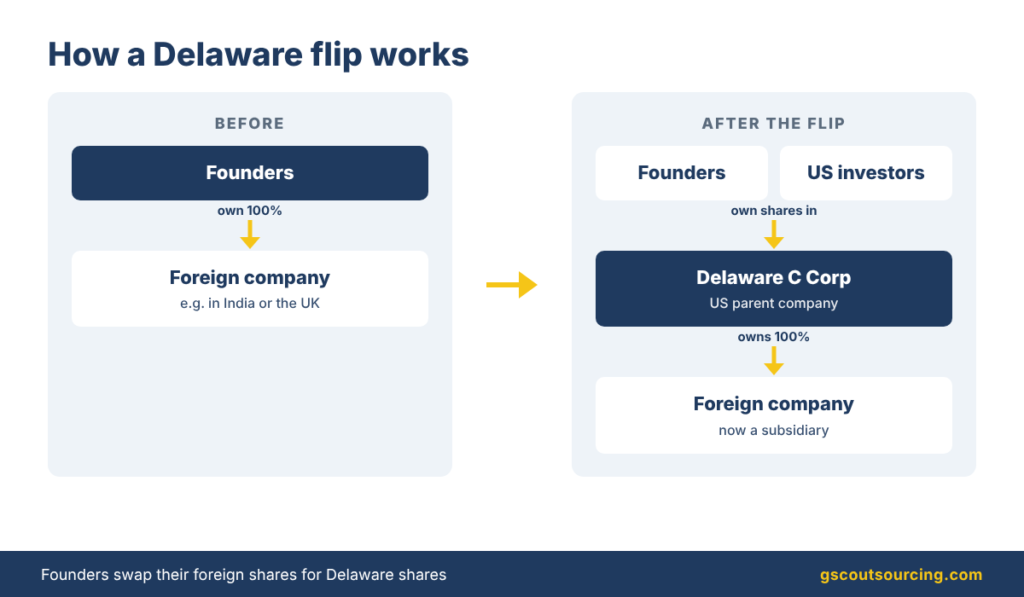
A Delaware flip makes a new Delaware C Corp the parent of your existing company abroad, so investors buy shares in the US company. The founders usually swap their foreign shares for Delaware shares.
1. Get advice in both countries. Your home country may tax the share swap or restrict outbound investment. Check this first.
2. Form the Delaware C Corp. Adopt bylaws, appoint directors and set the authorized share count.
3. Move ownership. Founders exchange their foreign shares for Delaware shares, or the Delaware company buys the foreign company.
4. Move or license the IP. Investors want the core intellectual property owned by, or licensed to, the US company.
5. Get an EIN and a US bank account. These are needed before investors can wire money.
6. Set up filings. The US parent files Form 1120 each year, plus Form 5472.
One trap: The Tax Adviser, published by the AICPA, notes that Delaware shares issued in exchange for foreign company shares may never qualify as QSBS. If you or your early investors are or will be US taxpayers, plan for this. Forming the Delaware C Corp first avoids the problem.
How much does a Delaware C Corp cost to keep each year?
Every Delaware corporation files an annual report and pays franchise tax by March 1. The state minimum is $175 plus a $50 report fee, but the default calculation can produce a much larger bill.
| Yearly item | What it is | Key numbers |
| Delaware annual report | Filed with the Division of Corporations | Due March 1; $50 fee; $200 late penalty |
| Delaware franchise tax | Based on authorized shares or assumed par value capital | Minimum $175 or $400; maximum $200,000 |
| Registered agent | A Delaware address that receives legal mail | Required every year |
| Federal Form 1120 | Corporate income tax return | 21% federal rate on profit |
| Form 5472 | Reports dealings with foreign owners (25% or more) | $25,000 penalty for not filing |
The franchise tax surprise catches many founders. Delaware first bills using authorized shares. A startup with 10,000,000 authorized shares would owe $85,165 that way. You can recalculate with the assumed par value capital method, using issued shares and gross assets, and pay the lower amount. For an early startup that is often the $400 minimum.
| Never miss a Delaware or IRS deadline We handle yearly taxes and filings for foreign-owned companies, including Form 5472, and give you a US deadline calendar from day one. Plan your formation |
What do investors check before they invest?
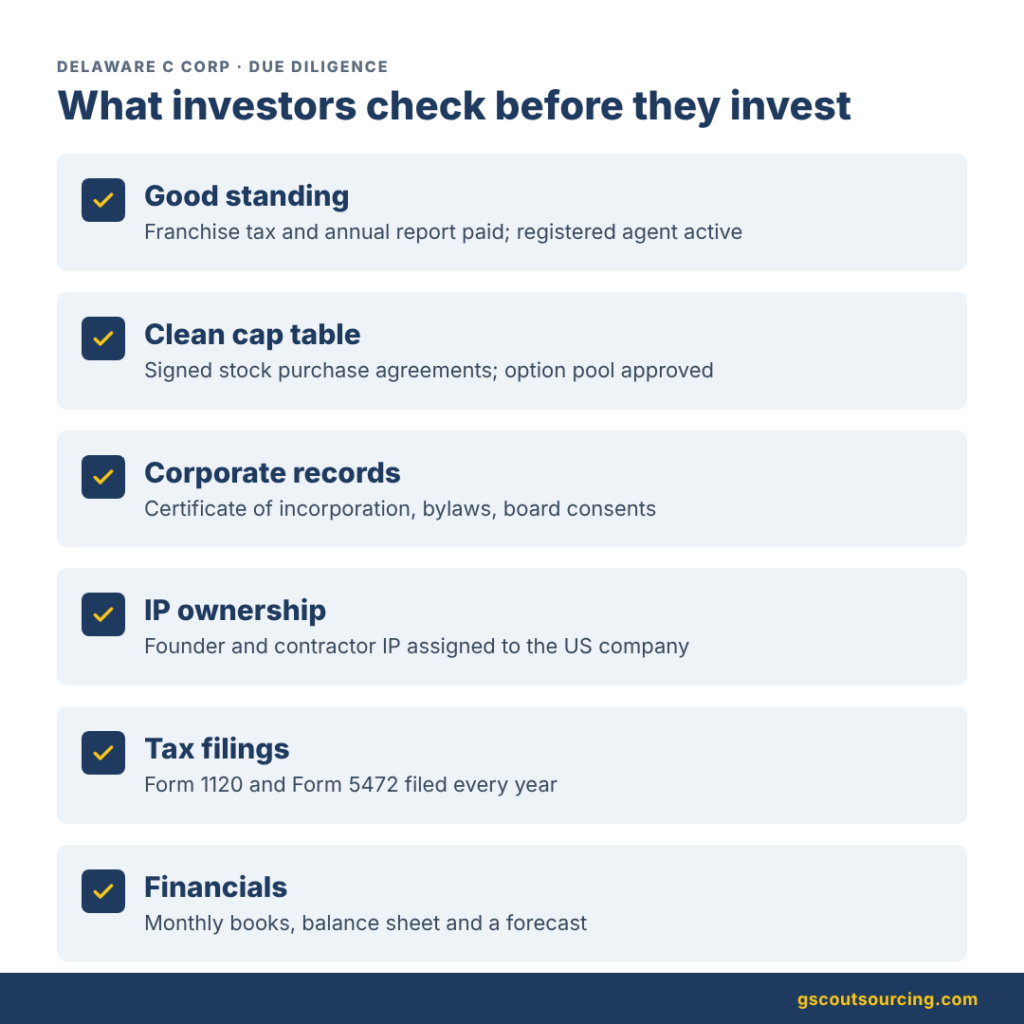
Investors run due diligence before they wire money. They check that the company exists in good standing, that founders own their shares properly and that taxes and filings are current.
| Investor check | What to have ready |
| Good standing | Delaware franchise tax and annual report paid; registered agent active |
| Clean cap table | Signed stock purchase agreements for every founder share; option pool approved by the board |
| Corporate records | Certificate of incorporation, bylaws, board and stockholder consents |
| IP ownership | Founder and contractor IP assignment agreements to the US company |
| Tax filings | Form 1120 and Form 5472 filed for every year since formation |
| Financials | Monthly books, a current balance sheet and a forecast |
Clean books speed this up. Monthly bookkeeping and close and an investor-ready financial model answer most finance questions before they are asked.
Is Delaware still the right choice in 2026?
For a startup raising from US investors, yes. Some public companies have moved to Texas or Nevada, but Delaware formations rose more than 15% in 2025, to 334,461 new entities, according to the state.
Your investors will usually tell you what they want. US-formed companies are also exempt from FinCEN beneficial ownership reporting, a rule FinCEN made final in August 2026, so that filing is not on the list for a Delaware C Corp.
Frequently asked questions
Why do investors prefer a Delaware C Corp?
Investors prefer a Delaware C Corp because Delaware corporate law is well tested, its business court is predictable, and standard US deal documents are written for it. A C Corp can issue preferred stock and stock options, and it keeps profit inside the company, which suits venture funds and their own investors.
Can a non-US citizen own a Delaware C Corp?
Yes. Delaware has no citizenship or residency rule for shareholders, directors or officers. A founder abroad can own 100% of the company. You need a registered agent with a Delaware address, an EIN from the IRS, and you must file a federal return and Form 5472 if foreign owners hold 25% or more.
What is a Delaware flip?
A Delaware flip is a restructuring that makes a new Delaware C Corp the parent of an existing foreign company. Founders usually swap their foreign shares for Delaware shares. It lets US investors buy into a US company, but it can trigger tax at home and may affect QSBS, so plan it with advisers.
How much is Delaware franchise tax for a startup?
The minimum is $175 under the authorized shares method or $400 under the assumed par value capital method, plus a $50 annual report fee, due March 1. A startup with millions of authorized shares can receive a large first bill, so recalculate using the assumed par value capital method and pay the lower amount.
Do I need a Delaware C Corp to raise money in the US?
Not by law, but most US venture funds and accelerators expect one. Some angels will invest in other states or structures. If you plan to raise institutional money, a Delaware C Corp avoids delays and a conversion later. If you are not raising, an LLC may suit you better.
Does a Delaware C Corp pay tax in Delaware?
Every Delaware corporation pays the yearly franchise tax and annual report fee. Delaware corporate income tax applies to corporations doing business in Delaware, so a startup that operates elsewhere usually pays income tax in the states where it has staff, offices or sales instead, plus the 21% federal corporate tax.
| Get your Delaware C Corp investor-ready from day one Investors move faster when the company is clean. GSC Outsourcing forms Delaware C Corps for founders outside the US and keeps them in order after formation. Book your free 30-minute call |
Related reading: US Company Formation for Non-Residents: The Complete Step-by-Step Guide (2026) · LLC vs C Corp for Non-US Founders: Tax, Filings and How to Choose (2026)
