
You have decided to open a US company from abroad. The next question is the one every founder gets stuck on: LLC or C Corp?
Short answer on LLC vs C Corp for non-US founders: choose an LLC if you run a service, agency or online business and want simple, pass-through tax. Choose a C Corp if you plan to raise money from US investors, issue stock options or keep profits in the company to grow.
Both can be owned 100% by a non-resident. They differ in who pays US tax, which forms you file and what investors accept. Below, each point comes with real numbers.
| Quick answers Can a non-resident own either one? Yes. Neither needs a US owner, visa or address beyond a registered agent. Who pays US tax on LLC profit? The owner, on a personal US return, if the profit is from a US trade or business. Who pays US tax on C Corp profit? The company, at a flat 21% federal rate. Can I use an S corp instead? No. Nonresident aliens cannot own S corporation shares. Can I switch later? Yes. An LLC can elect corporate tax treatment or convert to a corporation. |
What is the difference between an LLC and a C Corp?
An LLC (limited liability company) is a flexible US business entity that is usually taxed as a pass-through, so profit is taxed to its owners. A C Corp is a corporation taxed as its own taxpayer, so the company pays tax on profit before anything reaches the owners.
Both protect your personal assets from business debts. The real split is tax and ownership: an LLC has members and membership units, while a C Corp has shareholders, shares and a board.
How is a foreign-owned LLC taxed in the US?
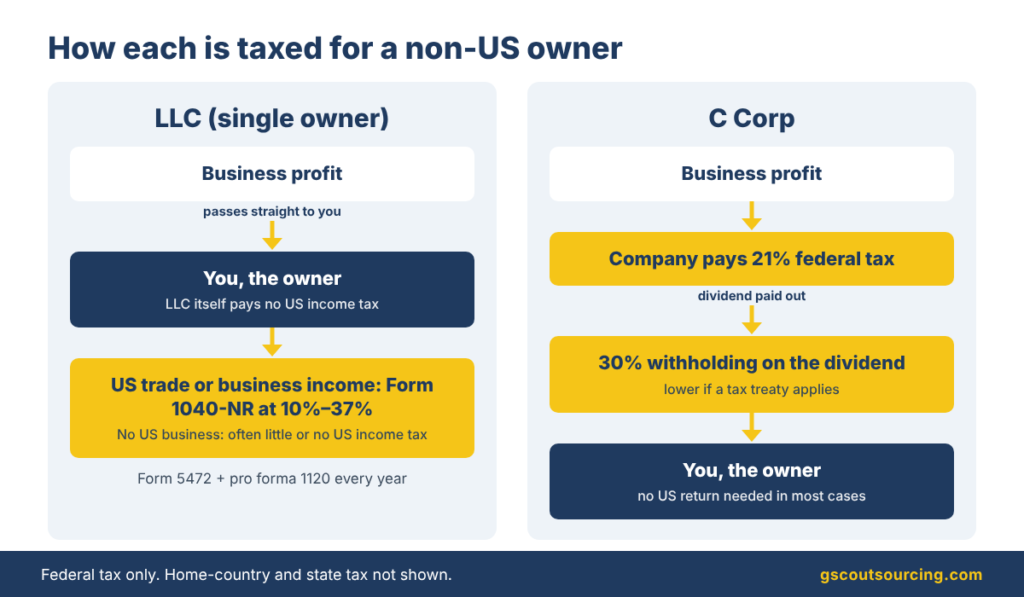
A single-member LLC owned by a non-resident is ignored for US income tax. If the business earns income connected with a US trade or business, the owner reports it on Form 1040-NR and pays tax at graduated rates. Either way, the LLC files Form 5472 every year.
• Effectively connected income (ECI). If you have a US trade or business, for example US staff, a US office or a US agent selling for you, that profit is taxed to you personally after deductions. The 2027 rates run from 10% to 37%.
• No US trade or business. If you work from abroad with no US presence, the LLC may owe little or no US federal income tax. This depends on the facts, so get advice before you assume it.
• Form 5472 every year. A foreign-owned single-member LLC must file Form 5472 attached to a pro forma Form 1120, even with no income. The IRS penalty for not filing is $25,000. The form cannot be e-filed; it goes by fax or mail.
• Two or more owners. A multi-member LLC is taxed as a partnership by default and files Form 1065. If it has US business income, it must withhold tax on each foreign partner's share, at 37% for individuals and 21% for corporate partners.
Your home country is the other half of the picture. Many countries tax their residents on worldwide income, so LLC profit may also be taxed where you live. Some tax authorities treat a US LLC as a company, not a pass-through, which can make foreign tax credits harder to claim. Check your home rules before you form.
How is a C Corp taxed when the owners live abroad?
A C Corp pays a flat 21% federal tax on its profit. When it pays a dividend to a foreign owner, the company withholds 30% of the dividend for the IRS, unless a tax treaty sets a lower rate.
You usually do not need a personal US return just because you own shares and receive dividends with the right tax withheld. The company files Form 1120 each year, and if foreign owners hold 25% or more, it also files Form 5472.
Here is a simple example on $100,000 of profit, before any state or home-country tax:
| Step | No treaty | With a 15% treaty rate |
| Profit | $100,000 | $100,000 |
| Federal corporate tax at 21% | $21,000 | $21,000 |
| Dividend paid out | $79,000 | $79,000 |
| Withholding on the dividend | $23,700 (30%) | $11,850 (15%) |
| Total US tax | $44,700 | $32,850 |
| Cash in your hands | $55,300 | $67,150 |
That assumes you pay out everything. If the company reinvests its profit, only the 21% applies for now.
LLC vs C Corp for non-US founders: how do they compare?
An LLC is usually cheaper and simpler for a small, profitable business that pays out its earnings. A C Corp is usually better for a company that raises money, grants equity or keeps profits inside.
| Point | LLC (single owner, default) | C Corp |
| Who pays US income tax | The owner, on US business profit | The company, at 21% |
| Tax on payouts | None at the LLC level | 30% withholding on dividends, or treaty rate |
| Main yearly federal forms | Form 5472 + pro forma 1120; 1040-NR if you have US business income | Form 1120; Form 5472 if 25%+ foreign-owned |
| Raising from US venture funds | Hard; most funds will not invest | Standard |
| Stock options for staff | Not available (profits interests instead) | Yes |
| QSBS for US investors | No | Possible, if requirements are met |
| S corp election | Not available to non-resident owners | Not available to non-resident owners |
| Example state cost (Delaware) | $400 annual tax by June 1 | From $175 franchise tax plus $50 report fee by March 1 |
| Best fit | Services, agencies, freelancers, online sellers | Startups raising money or planning an exit |
Which should I choose for my business?
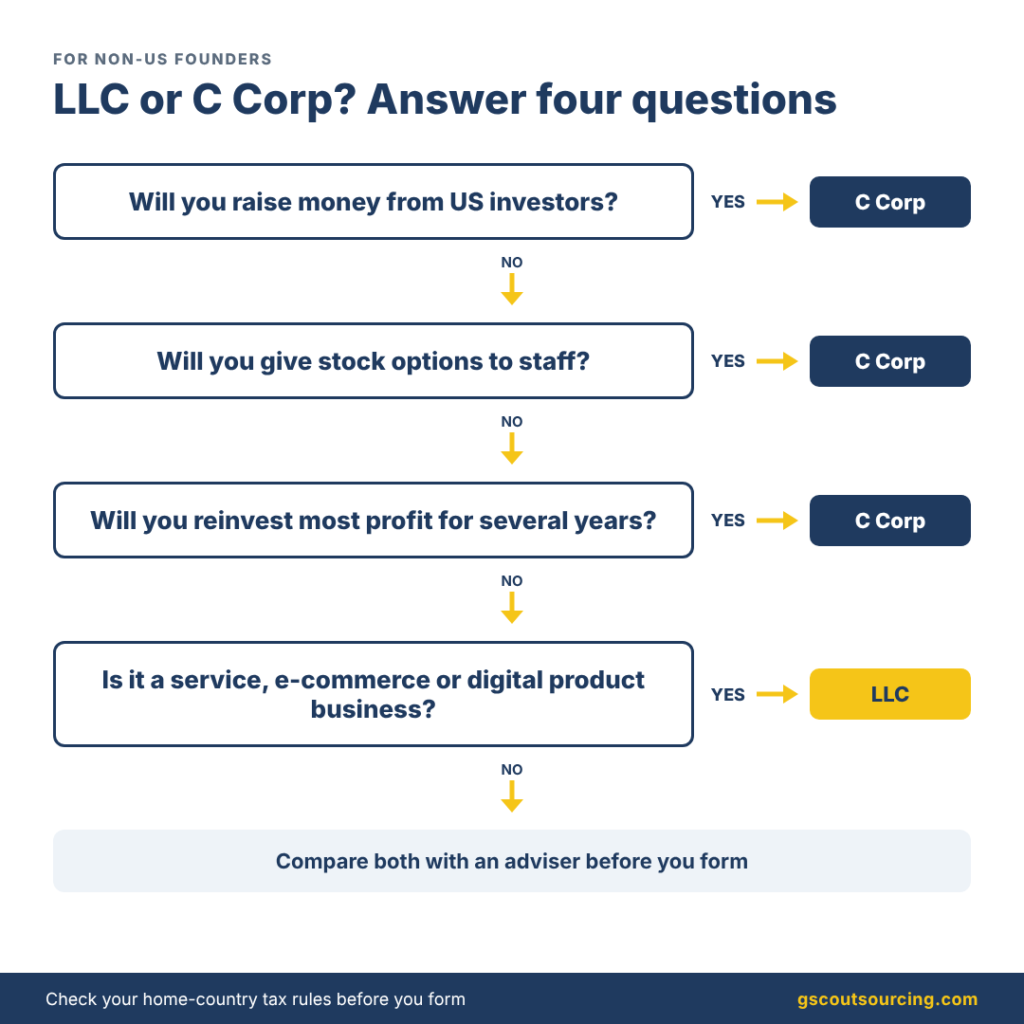
Pick the entity that fits how you will make money in the next two to three years, not the one that sounds bigger.
1. Agency, consulting or freelance work for US clients: an LLC usually fits and keeps tax simple.
2. E-commerce or digital products: an LLC often fits, as long as you track whether you have a US trade or business.
3. SaaS or tech startup that will raise money: a C Corp, usually in Delaware.
4. You want to reinvest most profit for years: a C Corp can cost less, because only the 21% applies until you pay dividends.
5. Two or more foreign partners: compare an LLC taxed as a partnership with a C Corp. Partnership withholding and filings add work.
Whichever you choose, keep business and personal money apart from day one. Bookkeeping that keeps owner money separate makes every return easier. For a longer walk through forming, banking and the EIN, read our US company formation for non-residents guide.
| Already formed and unsure it was the right call? Our US tax compliance service reviews your current filings, and our formation team can help you restructure if needed. Talk to the formation team |
Can I switch from an LLC to a C Corp later?
Yes. An LLC can elect to be taxed as a corporation with IRS Form 8832, or it can convert into a corporation under state law. Investors usually want a real corporation, so plan on a legal conversion if you raise.
1. Confirm the reason. A raise, stock options or a plan to reinvest are the usual triggers.
2. Check home-country tax. The change can count as a disposal in some countries.
3. Convert with the state. Many states allow a direct conversion; check your state's rules.
4. Update the IRS and banks. The EIN, bank account and payment accounts need the new entity details.
5. Reset your filing calendar. Form 1120 replaces the old LLC filings from the date of the change.
Switching works, but it costs time and fees, and any QSBS clock for US investors starts only once the shares exist. If a raise is likely, starting as a C Corp is usually simpler. If your books need cleaning up first, accounting advisory can help.
Frequently asked questions
Can a non-resident own a US LLC or C Corp?
Yes. A non-resident can own 100% of a US LLC or C Corp. You do not need a US visa, a US partner or a US home address. You need a registered agent in the state of formation, an EIN from the IRS, and you must meet the yearly federal and state filings.
Does a foreign-owned LLC pay US tax?
It depends on the business. A single-member LLC does not pay federal income tax itself. If the owner has income connected with a US trade or business, the owner pays tax on Form 1040-NR. If there is no US trade or business, there may be little US tax, but Form 5472 is still due.
Is an LLC or C Corp better for a non-US founder?
An LLC is usually better for service businesses, freelancers and online sellers who take profits out each year. A C Corp is usually better for startups that will raise money from US investors, grant stock options or reinvest profits. The right answer also depends on how your home country taxes each one.
How much tax does a C Corp pay on dividends to foreign owners?
The C Corp first pays 21% federal tax on its profit. When it pays a dividend to a foreign owner, it withholds 30% for the IRS, unless a tax treaty between the US and the owner's country sets a lower rate. Check the treaty for your country before you plan payouts.
Can a non-resident form an S corporation?
No. An S corporation cannot have a nonresident alien as a shareholder. A non-resident founder can choose an LLC, taxed as a pass-through by default, or a C Corp. Some founders hear about S corp tax savings from US friends, but that option is only open to US citizens and residents.
Can I change my LLC to a C Corp later?
Yes. An LLC can elect to be taxed as a corporation by filing IRS Form 8832, or it can convert into a corporation under state law. Investors usually want a real corporation, so a legal conversion is the common route before a raise. Check home-country tax rules first, because the change may be taxable there.
| Not sure which one fits? Talk it through with a partner The right choice depends on how you earn money, where you live and whether you plan to raise. That is a short conversation, not a guess. Book a free 30-minute call with a partner at GSC Outsourcing. Book your free 30-minute call |
Related reading: US Company Formation for Non-Residents: The Complete Step-by-Step Guide (2026) · Form 5472 for Foreign-Owned US LLCs: Who Files, When and How to Avoid the $25,000 Penalty
