
A startup called Numica recently announced it had raised about $21 million to buy small US accounting firms from owners nearing retirement, according to Fortune and CPA Practice Advisor. It's one more sign of a problem many firm owners already feel: there are more partners ready to step back than people ready to take over.
The short answer: the CPA succession crisis is the gap between the number of firm owners nearing retirement and the number of successors or buyers ready to take their place. Whichever exit you choose, whether internal successor, merger or sale, your firm is worth more and transitions more smoothly when it has enough capacity, documented processes and a team that doesn't depend on you.
This guide explains why the crunch is happening now, the main succession options, and how to keep your firm running at full strength while you plan.
| Quick answers What's driving it? A wave of owner retirements, a thin pipeline of new CPAs and hard-to-fill experienced roles. What are the options? Internal successor, merger, sale to a larger firm or investor-backed buyer, or a planned wind-down. What do buyers look for? Recurring revenue, documented processes and a team that can run without the owner. When should you start? Several years before you plan to step back. What about capacity? Build it now, so clients aren't put at risk during the handover. |
What is the CPA succession crisis?
The CPA succession crisis is the shortage of successors and buyers for accounting firms whose owners are ready to retire, especially small and mid-size firms.
For decades, the path was simple. A senior manager became a partner, then bought out the founder over time. Today, many small firms have no one in that seat. Owners who planned to sell to a staff member are finding that the staff member doesn't want the risk, or left years ago.
The result is a market where retiring owners have fewer natural successors, and outside buyers are stepping in to fill the gap.
Why is it happening now?
Three pressures have arrived at the same time: a large group of owners near retirement, too few experienced people coming up behind them, and new buyers with money to spend.
• The retirement wave. CPA Practice Advisor, citing the AICPA, reports that about 75% of CPAs are set to retire within 15 years.
• Hiring is hard. In the AICPA's 2026 PCPS CPA Firm Top Issues Survey, finding and keeping experienced staff remained a top concern, and firms of every size ranked managing change around technology and AI as their No. 1 issue for the next five years.
• Buyers are active. Investor-backed groups are buying firms. Numica, for example, says it targets practices with annual billings from about $700,000 to $5 million, often run by owners close to retirement.
For owners, more buyers can be good news. But it also means the firms that are well run, well staffed and not dependent on one person will get the best terms.
What are your succession options?
Most CPA firm owners choose one of four paths. The right one depends on your team, your timeline and how much control you want over what happens to your clients.
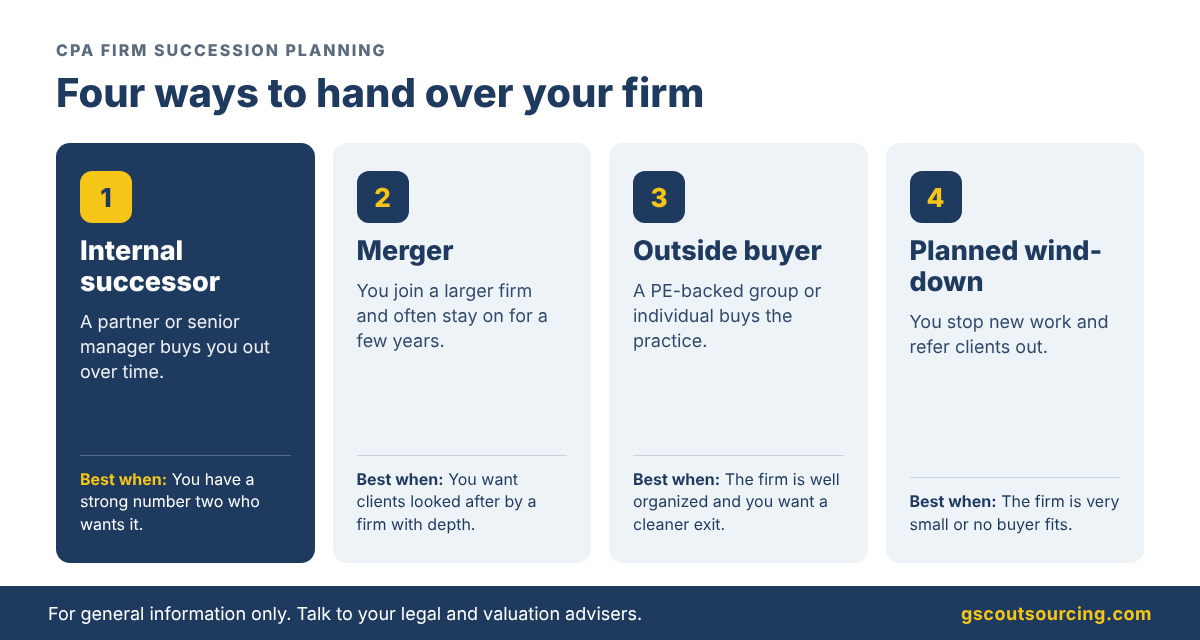
| Option | How it works | Works best when | Watch out for |
| Internal successor | A partner or senior manager buys you out over time | You have a strong number two who wants it | Payout depends on the firm doing well after you leave |
| Merger | You join a larger firm, often staying on for a few years | You want clients looked after by a firm with depth | Culture fit and how your staff are treated |
| Outside buyer | A private equity-backed group or individual buys the practice | You want a cleaner exit and the firm is well organized | Earn-outs, client retention terms, changes to service |
| Planned wind-down | You stop taking new work and refer clients out | The firm is very small or no buyer fits | Little or no sale value |
Whichever path you choose, involve your own legal and valuation advisers early. Deal terms vary widely.
What makes a CPA firm attractive to a buyer or successor?
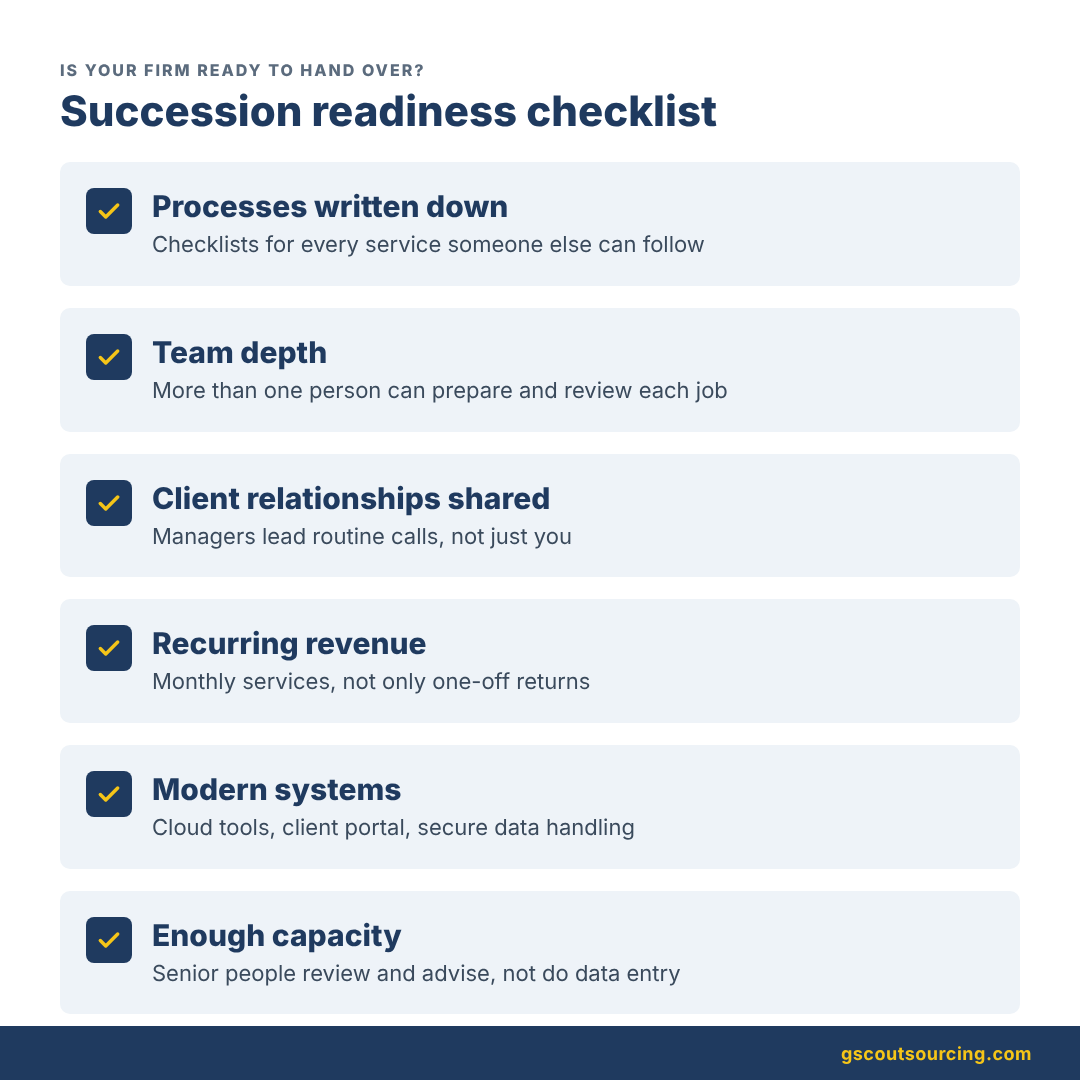
Buyers and successors pay for a firm that will keep running without you. That means steady revenue, clear processes and a team with enough depth to handle the work.
• Recurring revenue: monthly bookkeeping, payroll and advisory clients, not just one-off returns.
• Documented processes: checklists, workpaper standards and a clear review path someone else can follow.
• Staff depth: more than one person who can prepare and review each type of work.
• Low owner dependence: clients know and trust the team, not just you.
• Modern systems: cloud software, client portals and secure data handling.
• A balanced client base: no single client making up an outsized share of fees.
Most of these come down to capacity. A firm where the owner still does the work at 10 p.m. in March is hard to hand over to anyone.
How do you keep capacity during the transition?
Build a second layer under you now, so the work doesn't stop when you start stepping back. Start with processes, then people, then technology.
1. Write down how work gets done. Turn what's in your head into checklists for each service.
2. Move client relationships to your team. Bring a manager into meetings and let them lead routine calls.
3. Add preparation capacity. Free your senior people from data entry and first drafts, so they can review and advise. Offshore staff and outsourced support are two common ways to do this.
4. Update your systems. Move to cloud tools and a secure client portal. Buyers notice, and so do new hires.
5. Look at your service mix. Shift some one-off work toward recurring services where it makes sense.
If you're weighing which model fits, our guide to outsourcing vs offshore staffing compares the two, and why accounting firms are turning to offshore staffing in 2026 covers what other firms are doing.
| Need work done without adding headcount? Hand off defined work, such as bookkeeping or tax prep support, to a managed team with a senior reviewer on every account. See how outsourcing works → |
When should you start succession planning?
Start several years before you want to step back. Building team depth, moving client relationships and cleaning up processes all take time, and rushing them lowers what your firm is worth.
A simple way to begin is to answer three questions this year:
1. Who could run the firm, or each service line, if you stepped away for three months?
2. Which clients would leave if you weren't there, and why?
3. Which work could move off your desk in the next six months?
Your answers show where to build capacity first.
Frequently asked questions
What is the CPA succession crisis?
It is the shortage of successors and buyers for accounting firms whose owners are nearing retirement. Many small firms have no partner or senior manager ready to take over, while a large share of CPAs are expected to retire over the next 15 years, which leaves owners with fewer natural exit routes.
Who is buying CPA firms in 2026?
Larger accounting firms, private equity-backed groups and newer technology-led buyers are all active. Numica, for example, recently raised about $21 million to buy small US firms from owners near retirement. Each type of buyer offers different deal terms, so compare them carefully.
How early should a CPA firm owner plan for succession?
Several years before you plan to step back. It takes time to build a second layer of staff, move client relationships to your team and document processes. Firms that plan early usually have more choices and better terms than owners who start when they are ready to leave.
How can I make my CPA firm more valuable before selling?
Grow recurring revenue, document your processes, reduce how much clients depend on you personally, and make sure more than one person can prepare and review each type of work. Modern cloud systems and secure data handling also help a buyer feel confident about taking over.
Can offshore staffing help with succession planning?
Yes. Offshore staff take on preparation work, which frees your senior people to review, manage clients and step into leadership. That builds the team depth a successor or buyer looks for, and keeps service steady during the transition, often at a lower cost than a local hire.
What if no one inside my firm wants to take over?
You can still merge with a larger firm, sell to an outside buyer or plan a wind-down with client referrals. The stronger your processes, team and recurring revenue, the more options you'll have, so build those up while you explore buyers.
| Build the team your succession plan needs Whether you plan to hand over to a partner, merge or sell, your firm needs enough capacity to keep clients happy while you step back. That's where GSC Outsourcing helps. Book a free 30-minute call → |
Related reading: Why accounting firms are turning to offshore staffing in 2026 · AI for CPA Firms in 2026: What Actually Works, What to Avoid and How to Start in 30 Days · Tax Season Staffing: How CPA Firms Add Capacity for 2027
